American Pride: Fly Your Personal Flag: A Piece Of U.S. History
The Brands That Made America Great!
Companies Such As Case, International Harvester, And John Deere Were Vital To Rural American History. Today At ArtFactory.com We Are Preserving These American Icons To Never Be Forgotten By Future Generations
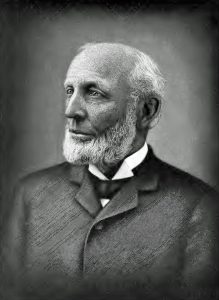
Jerome Increase Case (1819–1891) was an early American manufacturer of threshing machines. He founded the J. I. Case Corporation.
At ArtFactory.com we are not just a one-stop-shop for outfitting your man cave, game room, lady lounge, of commercial business, but are also committed to preserving historic memorabilia from companies vital to the history of the United States. That is why we have a wide section of rare signs from companies that were integral parts of the industrial, agricultural revolution, and are not just something to hang on your wall and forget about, but a museum quality item, that is also a conversation, and a unique way to "Fly Your Flag" as a proud American!
The reason they call rural American "The Heartland" is because without the hard working individuals and companies in these communities, our country simply would not eat. In the late 19th and early 20th centuries, driven entrepreneurs such as Jerome Increase Case, Cyrus Hall McCormick Jr.,William Deering, John Deere, and J.P.Morgan, and many others would fuel the industrial revolution that would turn the United States into the wealthiest nation in the world, and at this heart of that revolutions were the brands like International Harvester, Case, and John Deere. The "tractor wars" of the early 1900's would lead to unprecedented levels of innovation in the years leading up to, and following World War II. We talk a special pride in offering authentic signs and memorabilia from these iconic brands, and the important part of history that they represent.
Case Corporation History (Founded As J. I. Case Threshing Machine Company In 1842)
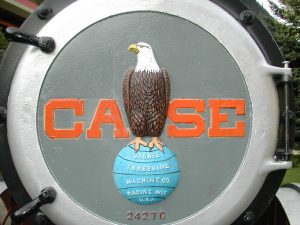
By Sfsorrow2 at English Wikipedia - Transferred from en.wikipedia to Commons by Oxyman using CommonsHelper., Public Domain.
The Case Corporation was a manufacturer of agricultural machinery and construction equipment. Founded, in 1842, by Jerome Increase Case as the J. I. Case Threshing Machine Company, it operated under that name for most of a century. For another 66 years it was the J. I. Case Company, and was often called simply Case. In the late 19th century, Case was one of America's largest builders of steam engines, producing self-propelled portable engines, traction engines and steam tractors. It was a major producer of threshing machines and other harvesting equipment. The company also produced various machinery for the U.S. military (combat engineer equipment for the USMC, full-tracked tractors and scoop loaders for the U.S. Army, etc.). In the 20th century, Case was among the ten largest builders of farm tractors for many years. In the 1950s its construction equipment line became its primary focus, with agricultural business second.
J. I. Case introduced an eagle logo for the first time in 1865 based on Old Abe, a Wisconsin Civil War Regiment's mascot. Case constructed his first portable steam engine in 1869, an engine used to power wheat threshers. This engine is in the Smithsonian Museum in Washington, D.C. Case won first place at the 1878 Paris Exposition in France for his thresher. This was the first thresher sent abroad by the Case company and was the first of thousands which would later be exported internationally. It is at this time that Case created his first self-propelled traction engine, with a drive mechanism on one of his portable engines.
Read More At: Case Corporation On Wikipedia
Case Eagle Neon Sign: Rare Vintage Farm Machinery Advertising – NS6345
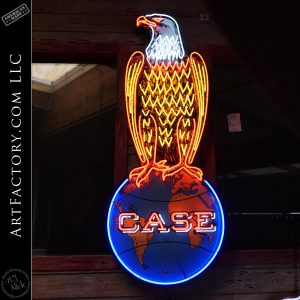
This Is An Extremely Rare, 1930’s Era, Die Cut Porcelain Enamel Sign, With Fully Rebuilt Neon, And Is An Original Case Farm Machinery Corporation Advertisement, Featuring The Famous “Abe The Eagle” Mascot, Based On Wisconsin’s 8th
Infantry Logo
A World Class Fine Art Petroliana Collectible, With 101 Point Museum And Investment Quality Neon And Electrical Restoration, Including All New Electrical Parts, Wiring, And Solid State Transformers, Signed And Certified By H.J. Nick
Case Corporation Historical Timeline
- 1842 - Company is founded by Jerome I. Case of Williamstown, NY.
- 1843 - Case moved company to Racine, Wisconsin for better access to water and power.
- 1863 - As the company grew, Case partnered with his top 3 employees Massena Erskine, Robert Baker and Stephen Bull.
- 1865 - Case introduces Abe the Eagle logo, based on Wisconsin’s 8th Infantry Division mascot.
- 1869 - Case constructed his first portable steam engine in 1869, an engine used to power wheat threshers.
- 1878 - Case won first place at the 1878 Paris Exposition in France for his thresher.
- 1890 - In 1890, the Case Company expanded to South America, opening a factory in Argentina.
- 1891 - Company founder J.I. Case passes away.
- 1895 - The Case Company had begun to produce gasoline engines.
- 1899 - The Case Company entered the Russian market.
- 1900 - By the start of the 20th century, Case was the most prolific North American builder of engines.
- 1902 - Five other major competing tractor manufactures merged, creating the International Harvester Company, thus creating their first major competition.
- 1904 - Case introduced the first all-steel thresher machine, and sold their first gasoline tractor.
- 1912 - During World War I Case began production of the 30-60 oil engine.
- 1919 - Competition heated up as John Deer entered the harvester business, International Harvester's purchased P&O Plowing of Canton, Illinois, and the Chattanooga Plowing company of Tennessee. Henry Ford also entered the tractor business with his Fordson Tractor.
- 1923 - The 100,000th thresher machine produced by Case made its way out of the assembly line.
- 1927 - Switched from steam engines to gas powered tractors. Case had built over 36,000 steam engines up until this time.
- 1929 - Case expanded to Australia, Mexico, Sweden, and other countries, and produced its first crawler tractor.
- 1940 - S and V tractors were introduced.
- 1941 - Became involved in the manufacturing of shells for the United States and allied forces military, as well as airplane parts for the B-26s, bombs, and doors for the Sherman Tank.
- 1942 - Opened three new plants, produced its first self-propelled combine, and released the company's first cotton picker.
- 1957 - Bought out the American Tractor Corporation, producer of small tractors and the most popular models of backhoe.
- 1964 - Acquired Colt Garden Tractors, the first garden tractor powered by 'Hy-Drive", a form of hydraulic propulsion that allowed for various heavy duty attachments and eliminated the need for transaxle drive belts. The Kern County Land Company, using oil money, bought the Case Company. In turn Kern County sold Case to Tenneco Company of Texas.
- 1983 - During purchase of International Harvester assets, Case sold its garden tractor division to Ingersoll Power Equipment. Ingersoll tractors would continue to carry the Case brand name until 1987.
- 1984 - Case parent Tenneco bought selected assets of the International Harvester agriculture division and merged it with J. I. Case. All agriculture products are first labeled Case International and later Case IH.
- 1999 - Case Corporation joined with New Holland N.V. to become CNH (Case-New Holland), now CNH Global, in November 1999. Because of the merger, CNH was forced to release its production plants in Doncaster, England and Winnipeg, Manitoba, Canada. The Doncaster site was bought by the ARGO-group, owner of tractor builder Landini, and brought back the McCormick brand. The plant in Winnipeg was taken over by the Buhler family to start Buhler Tractors. Thus marking the end of the original J.I. Case Corporation.
Watch Man Cave Tour Video
International Harvester Company History

International 660 in rural Saskatchewan
The International Harvester Company (often abbreviated by IHC, IH, or simply International (colloq.)) was an American manufacturer of agricultural and construction equipment, automobiles, commercial trucks, lawn and garden products, household equipment, and more. It was formed from the 1902 merger of McCormick Harvesting Machine Company and Deering Harvester Company and three smaller manufactures: Milwaukee; Plano; and Warder, Bushnell, and Glessner (manufacturers of Champion brand). Its brands included McCormick, Deering, and later McCormick-Deering, as well as International. Along with the Farmall and Cub Cadet tractors, International was also known for the Scout and Travelall vehicle nameplates. In the 1980s all divisions were sold off except for International Trucks, which changed its parent company name to Navistar International (NYSE: NAV).
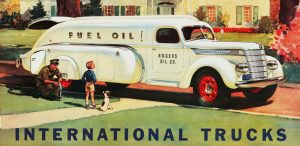
Advertisement for the 1940 International Tanker Truck. Photo By: - 1940 International Tanker Truck
Case International Created (1985)
Given its monumental importance to the building of rural communities the brand continues to have a massive cult following. The International Harvester legacy non-profits host some of the largest agriculture related events in the United States.
Following years of financial and economic decline, International began selling its separate equipment divisions, starting with the sale of the construction division to Dresser Industries in 1982. In November 1984 IH finalized a deal with Tenneco to sell the farm equipment division to Tenneco's subsidiary Case Corporation, and the brand continues as Case IH which is owned by CNH. The European division exists today as McCormick Tractors and is owned by ARGO SpA of Italy. International became solely a truck and engine manufacturer and reorganized as Navistar International in 1986. Throughout its existence International Harvester was headquartered in Chicago, Illinois. In 2020 Volkswagen agreed to fully purchase the remaining shares of Navistar.
Case International was created in 1985 when Tenneco bought selected assets of the agricultural division from International Harvester and merged it into its J.I. Case Company (IH then became Navistar).Today Case IH is owned by CNH Industrial, an American-Italian corporation.
Read More At: International Harvester Company On Wikipedia And Case Corporation On Wikipedia And Case (IH) International On Wikipedia
John Deere Company History

Portrait of John Deere
Deere & Company began when John Deere, born in Rutland, Vermont, United States on February 7, 1804, moved to Grand Detour, Illinois in 1836 to escape bankruptcy in Vermont. Already an established blacksmith, Deere opened a 1,378-square-foot (128 m2) shop in Grand Detour in 1837, which allowed him to serve as a general repairman in the village, as well as a manufacturer of tools such as pitchforks and shovels. Tools were just a start; the item that set him apart was the self-scouring steel plow, which was pioneered in 1837 when John Deere fashioned a Scottish steel saw blade into a plow. Prior to Deere's steel plow, most farmers used iron or wooden plows to which the rich Midwestern soil stuck, so they had to be cleaned frequently. The smooth-sided steel plow solved this problem and greatly aided migration into the American Great Plains in the 19th and early 20th centuries.
Increased competition during the early 1900s from the new International Harvester Company led the company to expand its offerings in the implement business, but the production of gasoline tractors came to define Deere & Company's operations during the 20th century.

Company logo used between 1912 and 1936
The company produced its first combine harvester, the John Deere No. 2, in 1927. A year later, this innovation was followed up by the introduction of John Deere No. 1, a smaller machine that was more popular with customers. By 1929, the No. 1 and No. 2 were replaced by newer, lighter-weight harvesters. In the 1930s, John Deere and other farm equipment manufacturers began developing hillside harvesting technology. Harvesters now had the ability to effectively use their combines to harvest grain on hillsides with up to a 50% slope gradient. On an episode of the Travel Channel series Made in America that profiled Deere & Company, host John Ratzenberger stated that the company never repossessed any equipment from American farmers during the Great Depression. During World War II, the great-grandson of John Deere, Charles Deere Wiman, was president of the company, but he accepted a commission as a colonel in the U.S. Army. Burton F. Peek was hired as president during this period. Before Wiman returned to work at the company in late 1944, he directed the farm machinery and equipment division of the War Production Board. In addition to farm machinery, John Deere manufactured military tractors, and transmissions for the M3 tank. They also made aircraft parts, ammunition, and mobile laundry units to support the war effort.
Read More At: John Deere On Wikipedia
International Harvester Neon Sign: Rare Original Vintage Porcelain – NS6499

A Genuine Piece Of Automotive And Agricultural History, Founded In 1902 The International Harvester Company’s Tractors, Trucks, And Farming Equipment Were At The Forefront Of The Industrial Revolution, Despite Closing Business In 1985, The Brand Maintains A Cult Following Today’s Due
To Its Importance To Rural Communities
Across America
This Is A Centerpiece Quality Item For Even The Most Serious Automobilia Collector, This Extra Large, Original Early Twentieth-Century Porcelain Enamel Sign Features A 101 Point Neon Restoration, With All New Electrical Components And Solid State Transformers, Neon Blown By Our In-House Master Glass Blowers, And Has Received H.J. Nick’s Brass Tag Signature Certification As A World Class Fine Art, Museum And Investment Quality Piece Of Collectible Memorabilia
At ArtFactory.com We have The World's Largest Man Cave
At ArtFactory.com we have the world's largest man cave, and the largest selection of original, vintage collectible neon, porcelain and tin litho signs for sale anywhere. We have hundreds of signs currently for sale, and are adding new inventory daily. Whether you are a beginning, intermediate, or advanced collector, we have something for you. This includes a wide selection of automobilia, petroliana, soda, general store, tobacciana signs, and many more. Furthermore, in addition to signs, we also have authentic visible gas pumps and old vending machines that we have restored to working, museum quality collectible condition, just as a new machine would have delivered from the original manufacture. Our restorations are the best in the business because nobody has been doing it longer, or takes as much attention to detail. Additionally, it is our belief that old porcelain and tin signs should be kept in original, unrestored condition, and that any dings, dents, blemishes, and in some cases even bullet holes are part of each item's unique history. However, all of our neon signs (unless otherwise stated) have had a 101 Point Neon and Electrical Restoration. These restorations include neon hand blown by our in- house master glass blowers, all new electrical components, wiring, and mounts, and all solid state transformers and/or flashers.
To top it all off, every antique and vintage collectible restoration completed by ArtFactory.com is done under the supervision, and according to the specifications of H.J. Nick. Not only that, but a restoration is not considered complete until it has received H.J. Nick's brass tag signature certification plaque. This certification ensures that the item is guaranteed to be "The Genuine Article", backed by our over a century of experience, with our word is our bond reputation and guaranteeing your money back “forever". The H.J. Nick Brass Tag Certification makes this item one of the highest appreciating, collectible investments that you can make. These items can be insured at stated value, usually on your home owners policy, for little added premium. Thus, making this a safer investment than even those insured by the FDIC, is much more fun to own, and puts you in control instead of the bank. The H.J. Nick brass tag certification also certifies the item to meet all world class fine art, museum and investment quality collectible standards, and that your collectible will function just as a brand new item would have been delivered from the original manufacture. This certification is recognized by collectors and insurers worldwide.