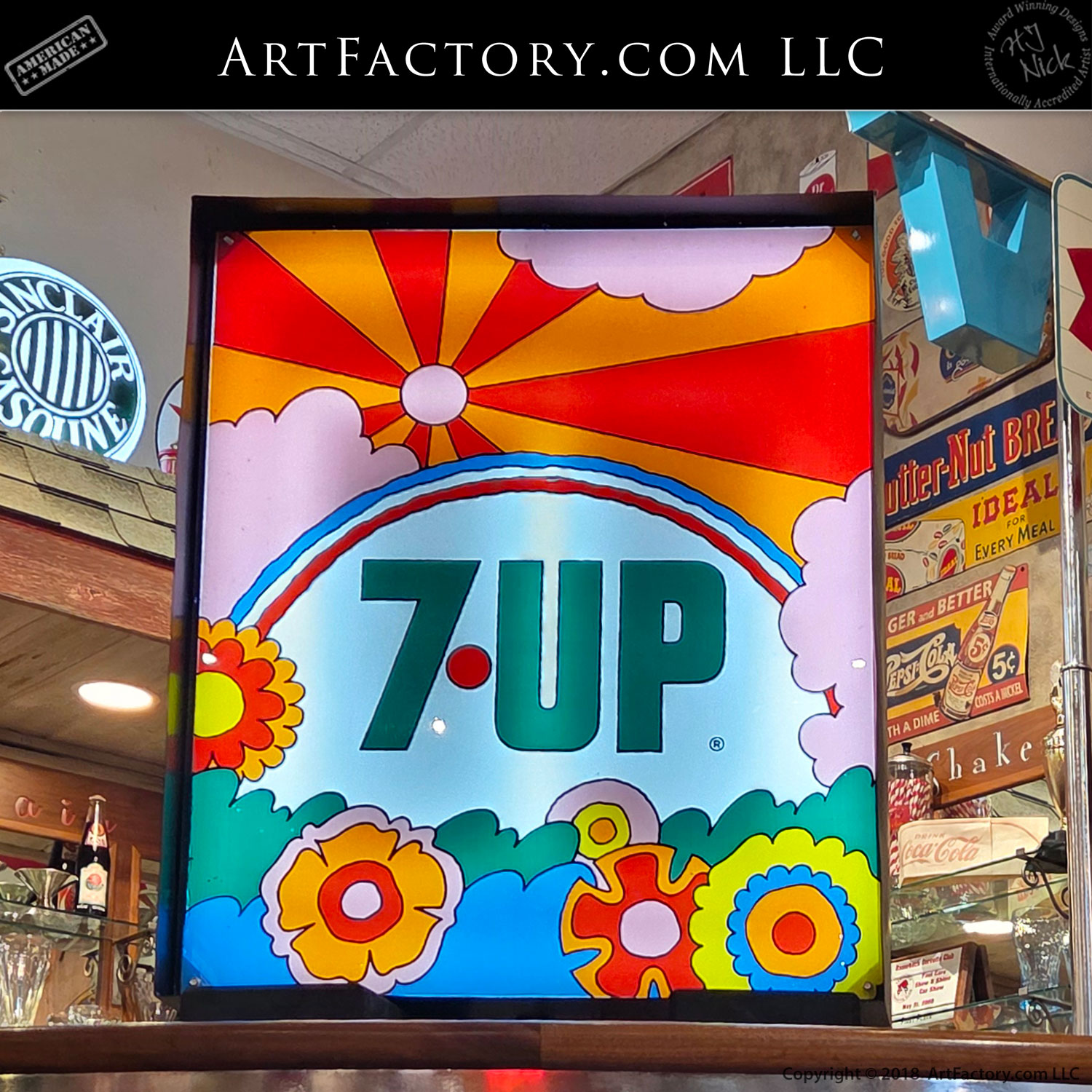
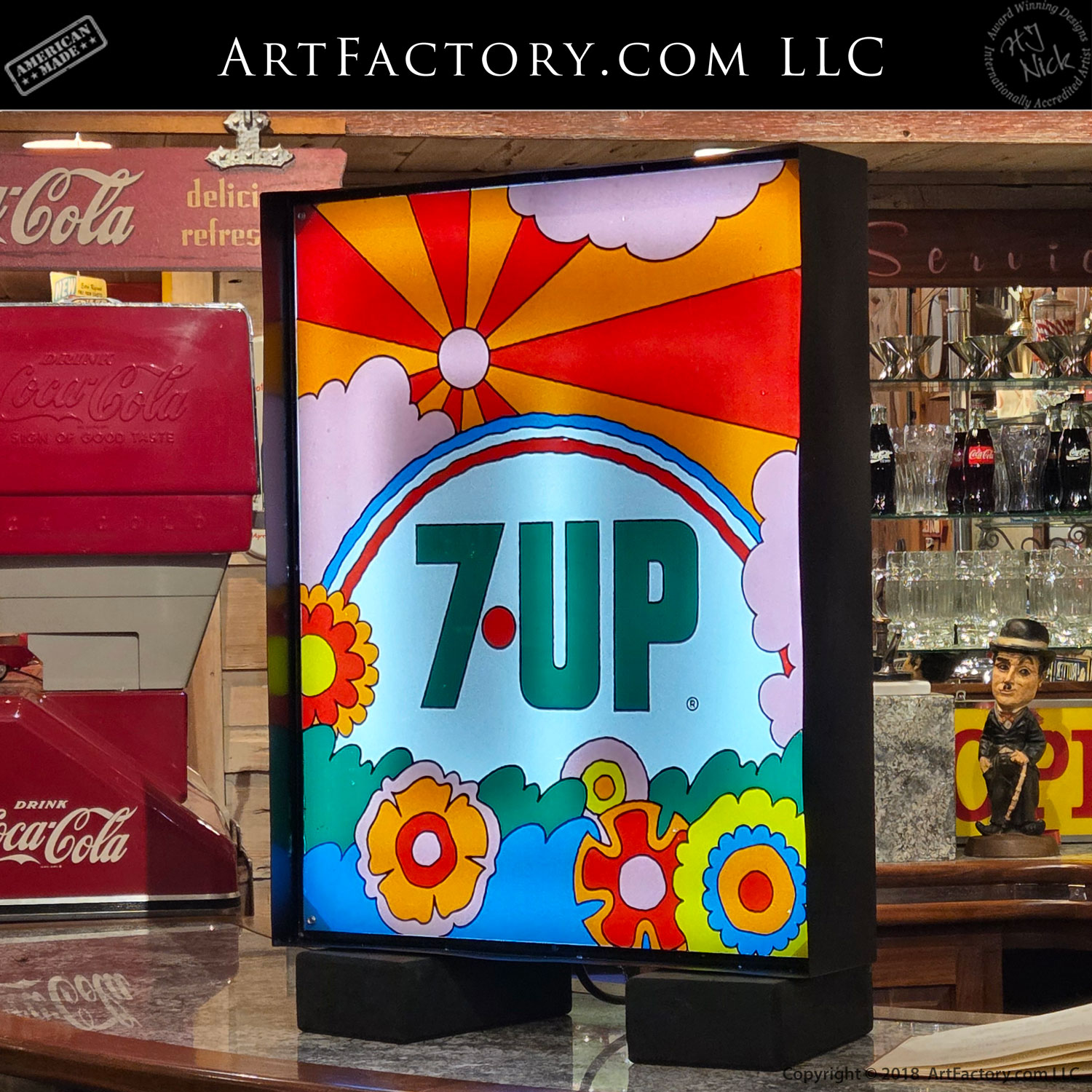

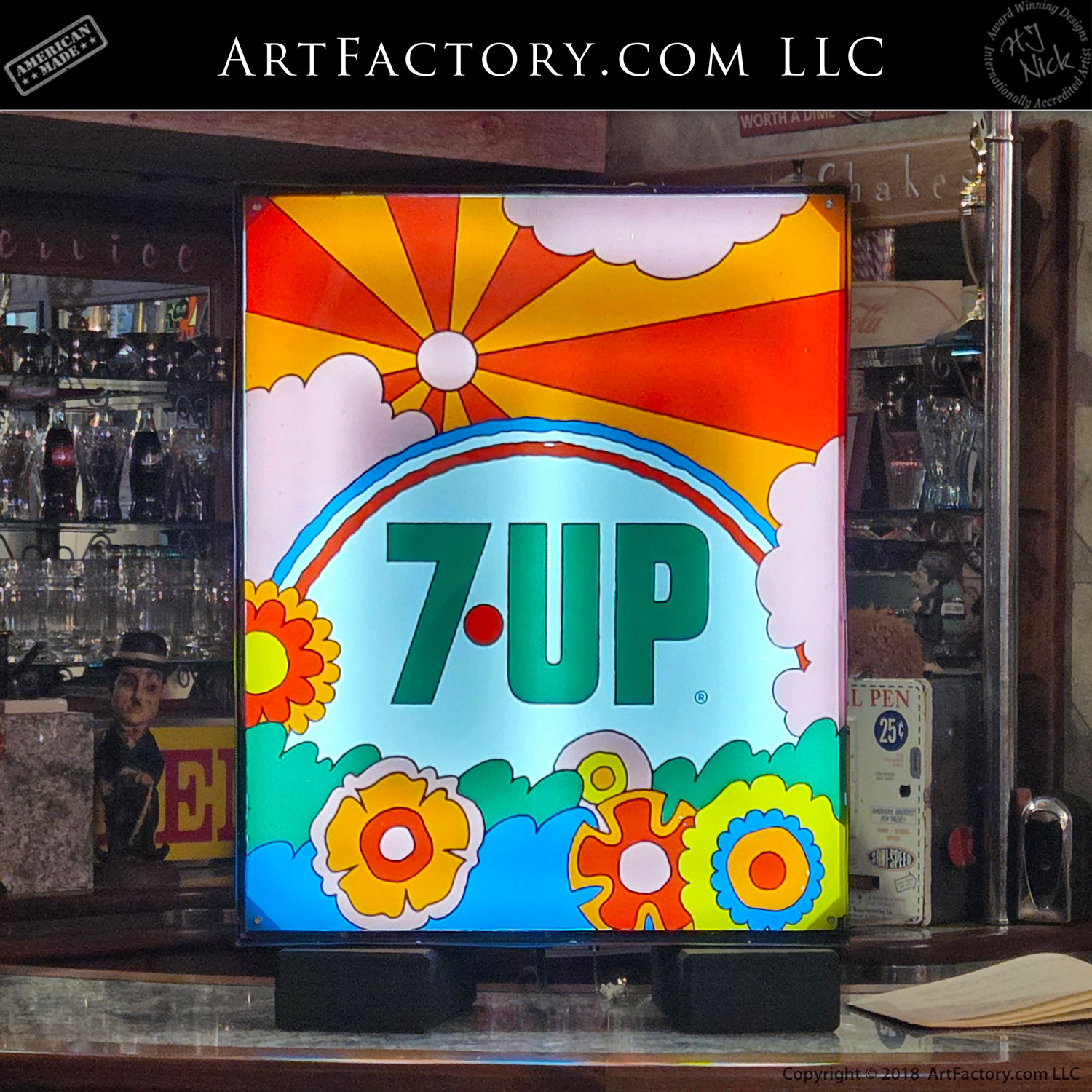
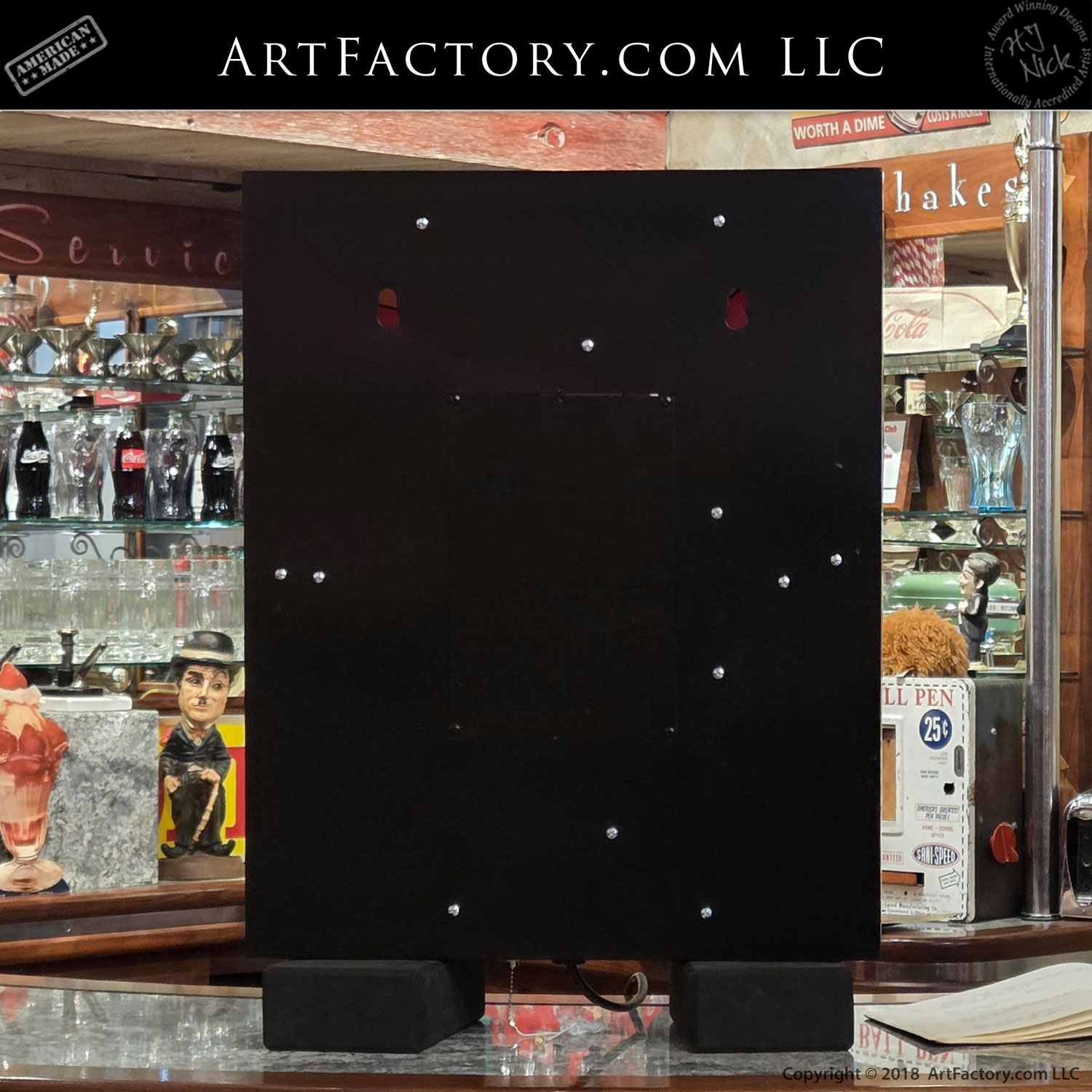
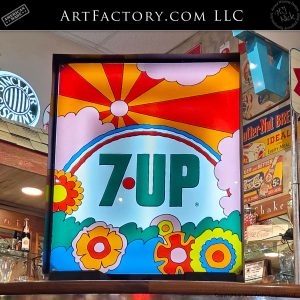
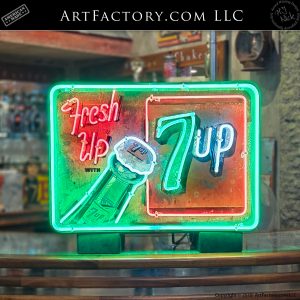
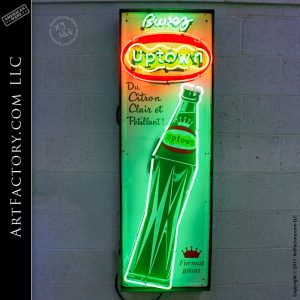
7 up back lit
The “Uncola” Counterculture Era
This original 1960s–1970s 7-UP illuminated sign captures one of the most brilliant and successful marketing pivots in American corporate history. Facing overwhelming market dominance from cola giants, the Seven-Up Company launched its revolutionary “Uncola” campaign in late 1967.
To appeal directly to the massive, influential baby boomer youth culture, 7-UP completely abandoned traditional, conservative soda advertising. Instead, they fully embraced the vibrant, surrealist, and psychedelic aesthetics defining the era, famously popularized by artists like Peter Max.

Description
The 7-Up® Company: A History of Corporate Brilliance and Visual Revolution
The historical importance of this vintage illuminated 7-UP sign is rooted in the dramatic mid-century transformation of the Seven-Up Company. What started as a medicinal tonic grew into one of the most daring, countercultural marketing triumphs in corporate history.
The Early Foundation
Invented by Charles Leiper Grigg in October 1929 — just two weeks before the devastating Wall Street crash — the soft drink was originally introduced with the clinical name Bib-Label Lithiated Lemon-Lime Soda. Early formulations contained lithium citrate, a mood-stabilizing drug, and the beverage was marketed as a patent medicine for curing hangovers and settling stomachs.
Eventually shortened to 7-UP, the brand spent its first few decades leaning on wholesome, conservative marketing campaigns. Slogans like You like it... it likes you! positioned the crisp beverage as a clean, refreshing, family-safe alternative to standard sodas. By the mid-20th
Specifications:
7-Up® Back-Lit Sign
- Type: Original Round Illuminated Sign
- Era: 1960s–1970s
- Manufacturer: Seven-Up Co. & Stout Sign Company,
St. Louis, MO - Dimensions: 22"W x 27.5"H, Weight is 20 lbs.
- Construction: Custom-fabricated solid steel
sign housing - Complete electrical restoration
- All new wiring and electrical components
- New fluorescent lighting system
- New fluorescent lamps installed
- Exclusive H.J. Nick Fast Keyhole Hanging System
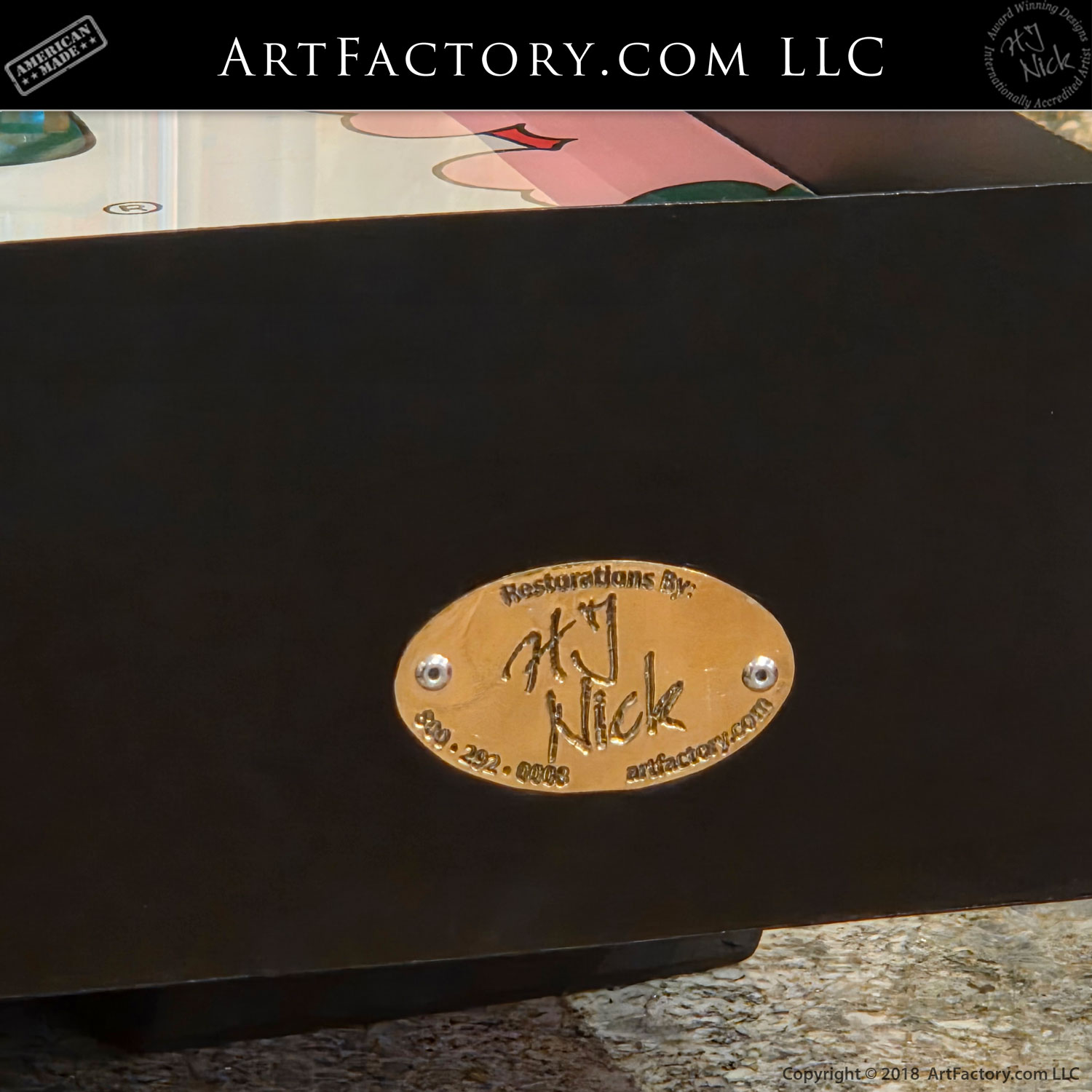
for quick, secure mounting - Official “Restorations By H.J. Nick” identification plaque mounted on rear
- Fully tested and ready for display
century, it found immense success as a premium mixer following the end of Prohibition. However, by the late 1960s, the company hit a massive commercial wall. The youth market viewed 7-UP as an outdated drink that only their parents drank.
The Birth of "The Uncola"
In late 1967, facing absolute market dominance from cola giants like Coca-Cola and Pepsi, the executives at 7-UP made a desperate and historic pivot. They hired the legendary advertising agency J. Walter Thompson to entirely reinvent the brand. Instead of trying to fit in with the established cola market, the agency brilliantly turned 7-UP’s differences into its greatest strength by launching The Uncola campaign in 1968.
By framing 1960s corporate giants as the establishment and 7-UP as the alternative, the brand aligned itself directly with the massive Baby Boomer youth movement and the anti-war, free-spirit counterculture.
To drive this visual rebellion home, 7-UP bypassed standard corporate graphic designers. They invited freelance artists, underground illustrators, and pop-art masters to submit wildly imaginative, psychedelic artwork. Influenced heavily by the vibrant, surrealist art style of Peter Max, Milton Glaser, and Heinz Edelmann, these campaigns exploded with brilliant, multi-colored rainbows, stylized clouds, radiant sunbursts, and whimsical pop-art flowers.
The Evolution into Illuminated Substrate Signs 
As the campaign became a roaring pop-culture success, 7-UP needed to translate these flat billboard and poster graphics into a physical medium that could capture attention inside commercial storefronts, neighborhood diners, drive-ins, and convenience stores. This necessity birthed the era of illuminated substrate and vacuum-formed plastic signage.
Prior to this period, most commercial signs relied heavily on heavy tin lithograph metal or fragile, exposed neon tubing. However, the complex, color-blended, surrealist nature of 1970s pop art could not be easily replicated in neon glass or stamped metal. Soft drink companies turned to translucent acrylic and vacuum-molded plastic panels.
By printing the vibrant, countercultural graphics directly onto a translucent face panel and backlighting it with internal fluorescent tubes, manufacturers created a sign that was highly vibrant and uniformly lit, mimicking a glowing canvas. It was fully capable of accurately showcasing complex, multi-color pop-art illustrations, while remaining lightweight and durable enough for active, heavy-duty commercial service behind busy lunch counters or store windows.
Why Surviving Examples are Scarcer Today
While these illuminated signs were manufactured in significant quantities during the peak of the 1970s Feeling 7UP and Uncola eras, very few survived intact. The translucent plastic face panels were highly susceptible to cracking under heat, fracturing from commercial impacts, or fading over decades of continuous exposure to UV light and fluorescent radiation. Furthermore, when corporate logo shifts occurred in the late 1970s and 1980s, the vast majority of these original counterculture signs were scrapped and thrown into dumpsters by store owners updating their branding.
An original, structurally stabilized 7-UP face from this visual revolution represents a prized anchor piece of Americana, marking the exact historic moment when American corporate advertising collided with fine modern art.
Watch Neon Sign Restorations Video
Watch Hanging Neon Sign Video
ArtFactory.com & H.J. Nick Brass Tag Certification Details
The H.J. Nick Brass Tag Certification ensures each piece to be the genuine item. Backed by our over a century of experience, with our word is our bond reputation and guaranteeing or your money back “forever". The H.J. Nick Brass Tag Certification makes this item one of the highest appreciating, collectible investments that you can make. These items can be insured at stated value, usually on your home owners policy, for little added premium. Thus, making this a safer investment than even those insured by the FDIC, is much more fun to own, and puts you in control instead of the bank.
✨ Visit H.J. Nick’s Art Factory Galleries ✨
7407 E Greenway Rd, Scottsdale Airpark, Scottsdale, AZ 85260
Monday – Friday | 8 AM – 4 PM MST
Walk-ins Welcome | Private Viewings by Appointment
📅 Appointments & Inquiries
📞 Call: 1-800-292-0008 – Ask for Karla
🌐 Website: www.artfactory.com

• ✈️ Jet Parking Available
• 🚗 Limousine Service Available

Reviews
There are no reviews yet.