


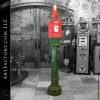
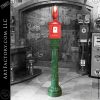
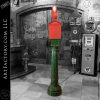
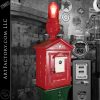






Fully Operational Gamewell Fire-Station Telegraph Alarm Box – FP7600
Unrestored American Firefighting History with Original Mechanism, Cast-Iron Pedestal and Illuminated Red Signal
This monumental Gamewell fire-alarm station is an authentic survivor from the era when precision machinery, dedicated telegraph circuits and the immediate response of America’s firefighters protected entire communities.
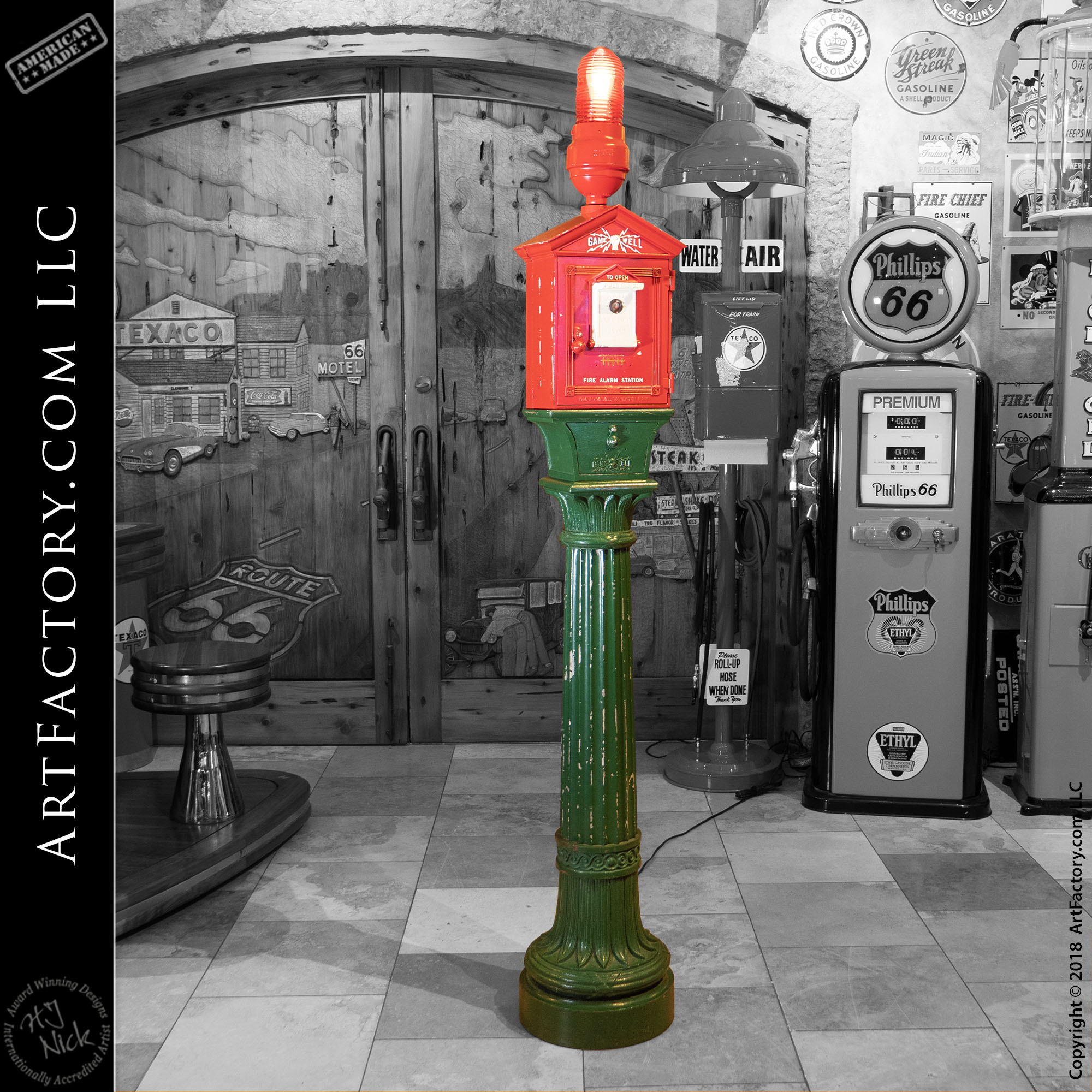
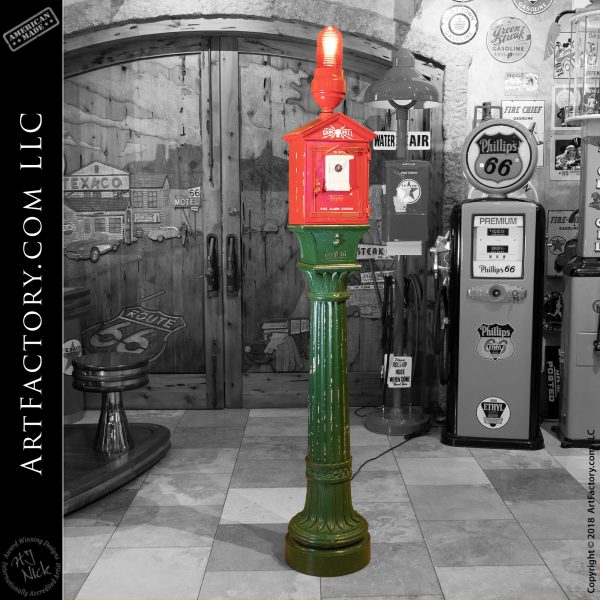
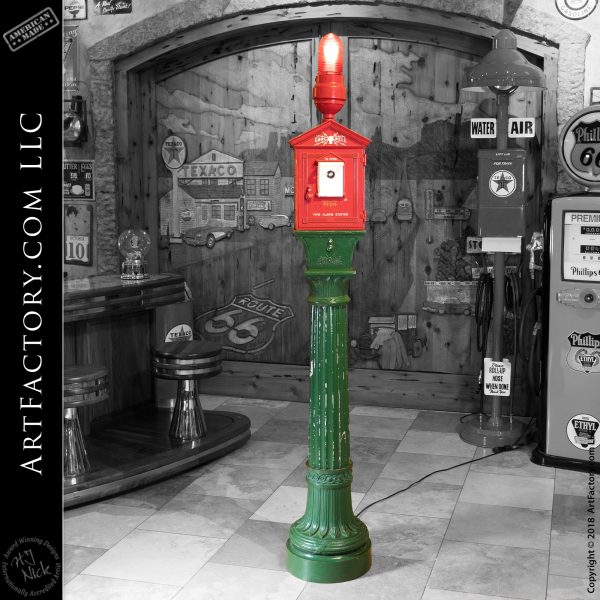
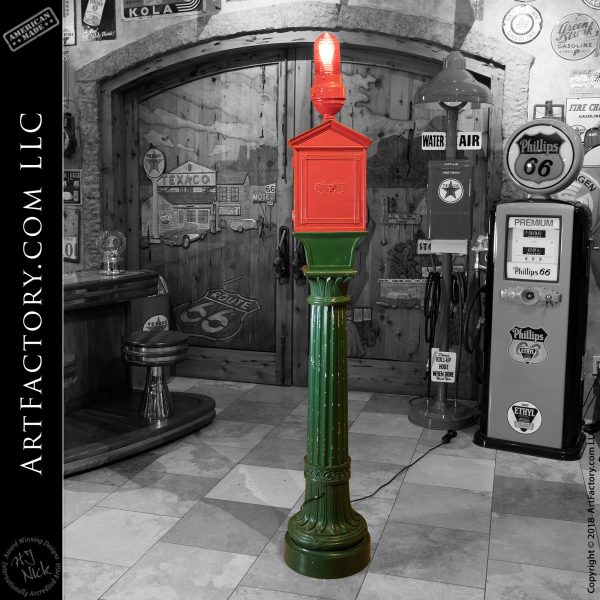
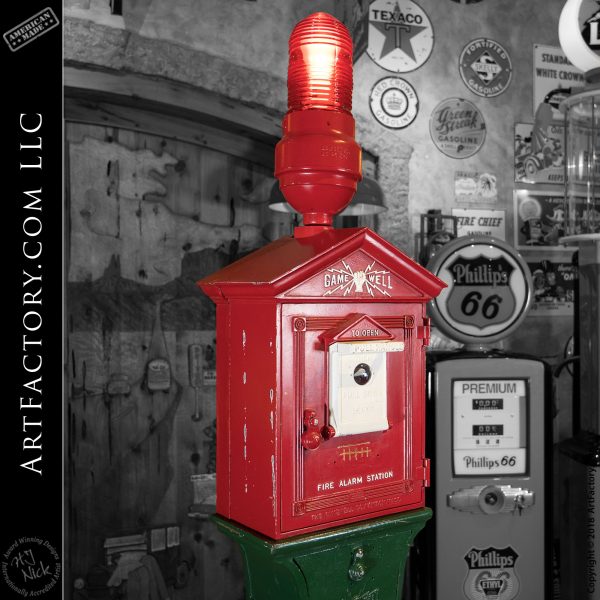
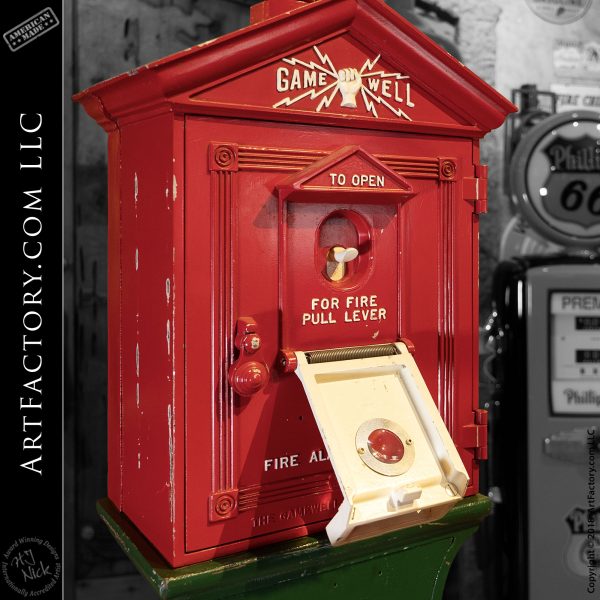
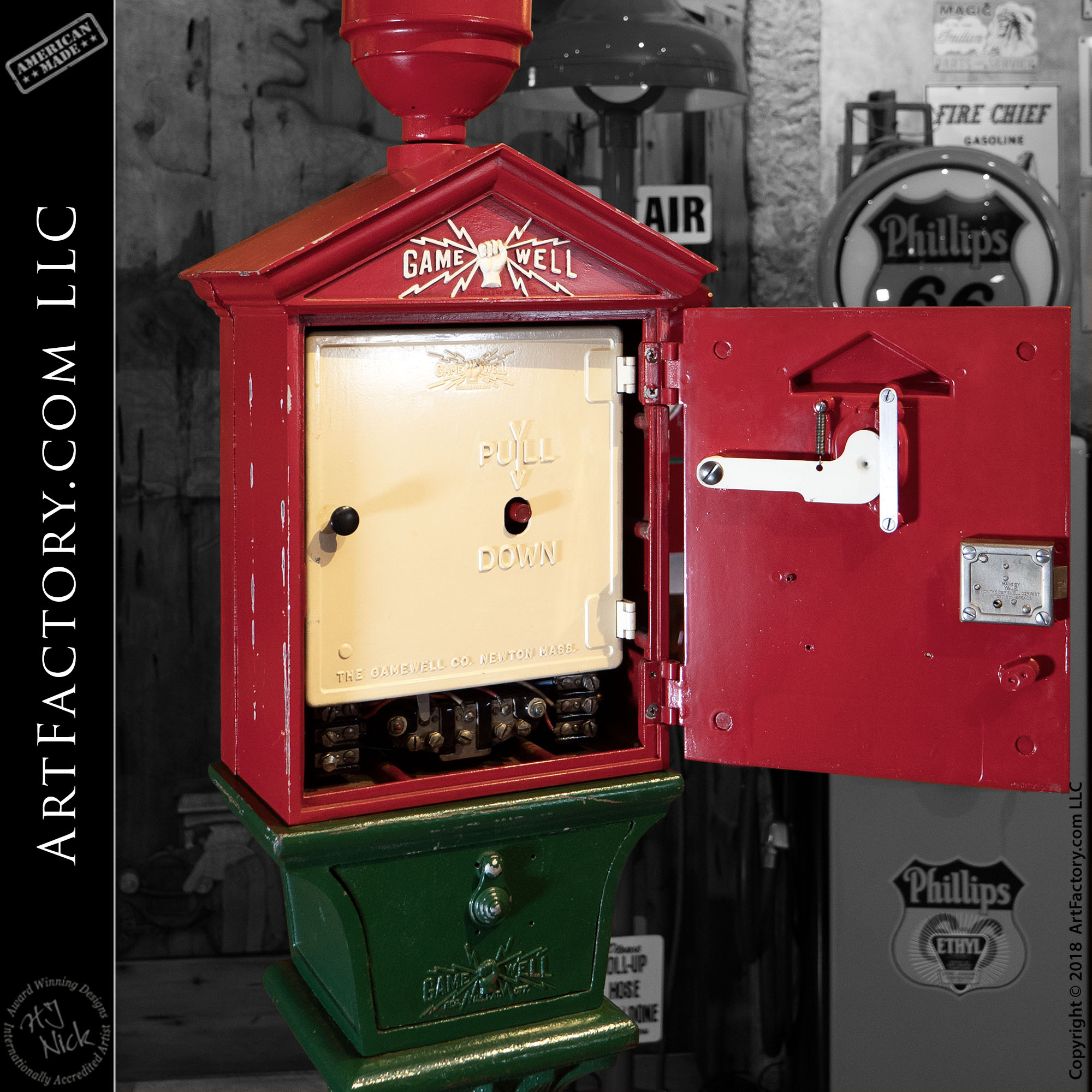
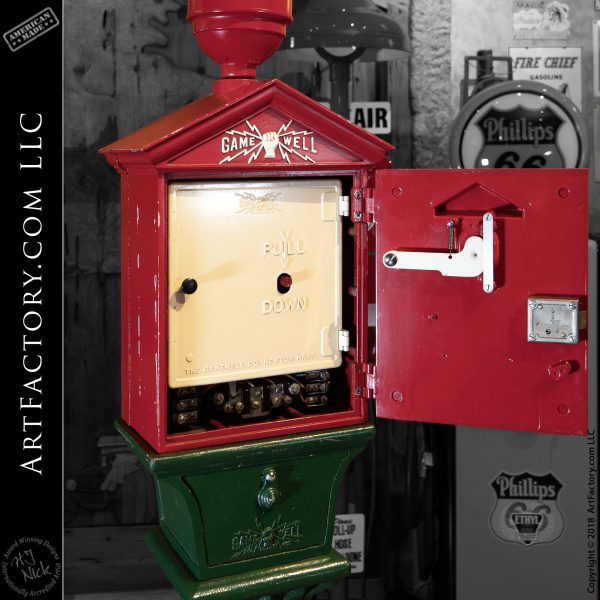
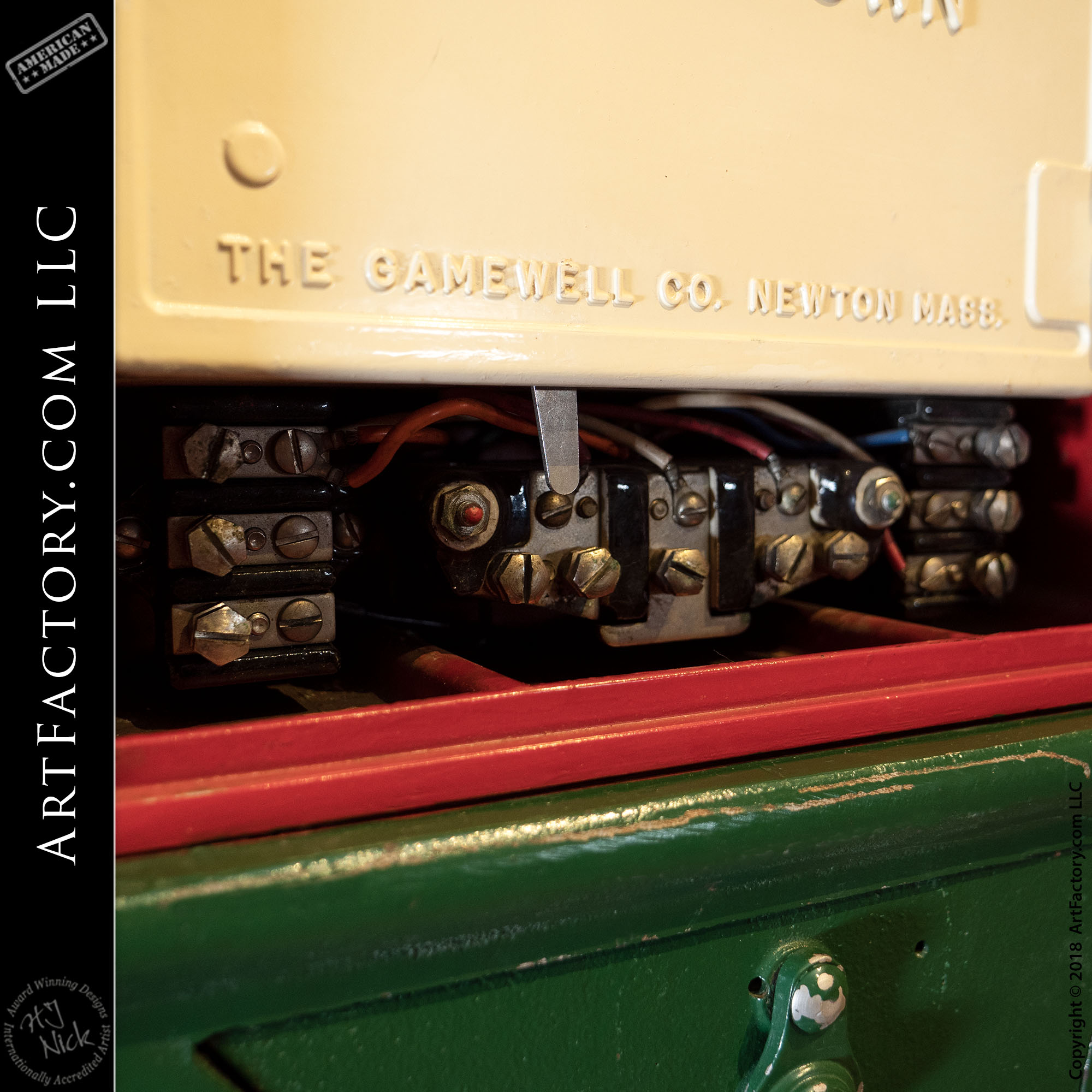
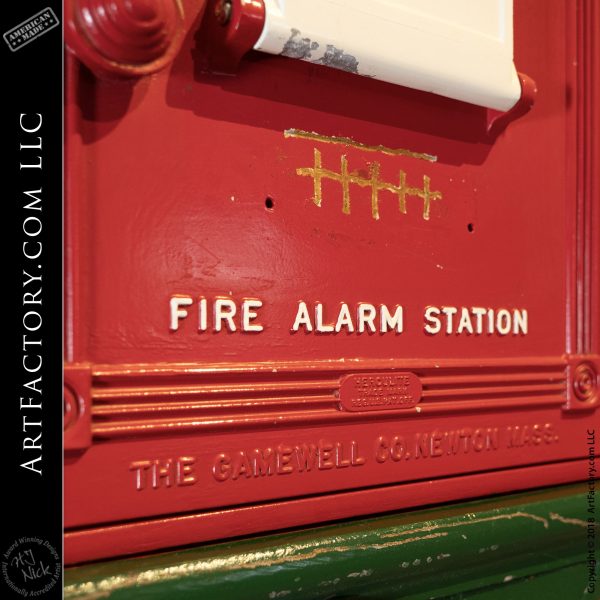
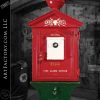
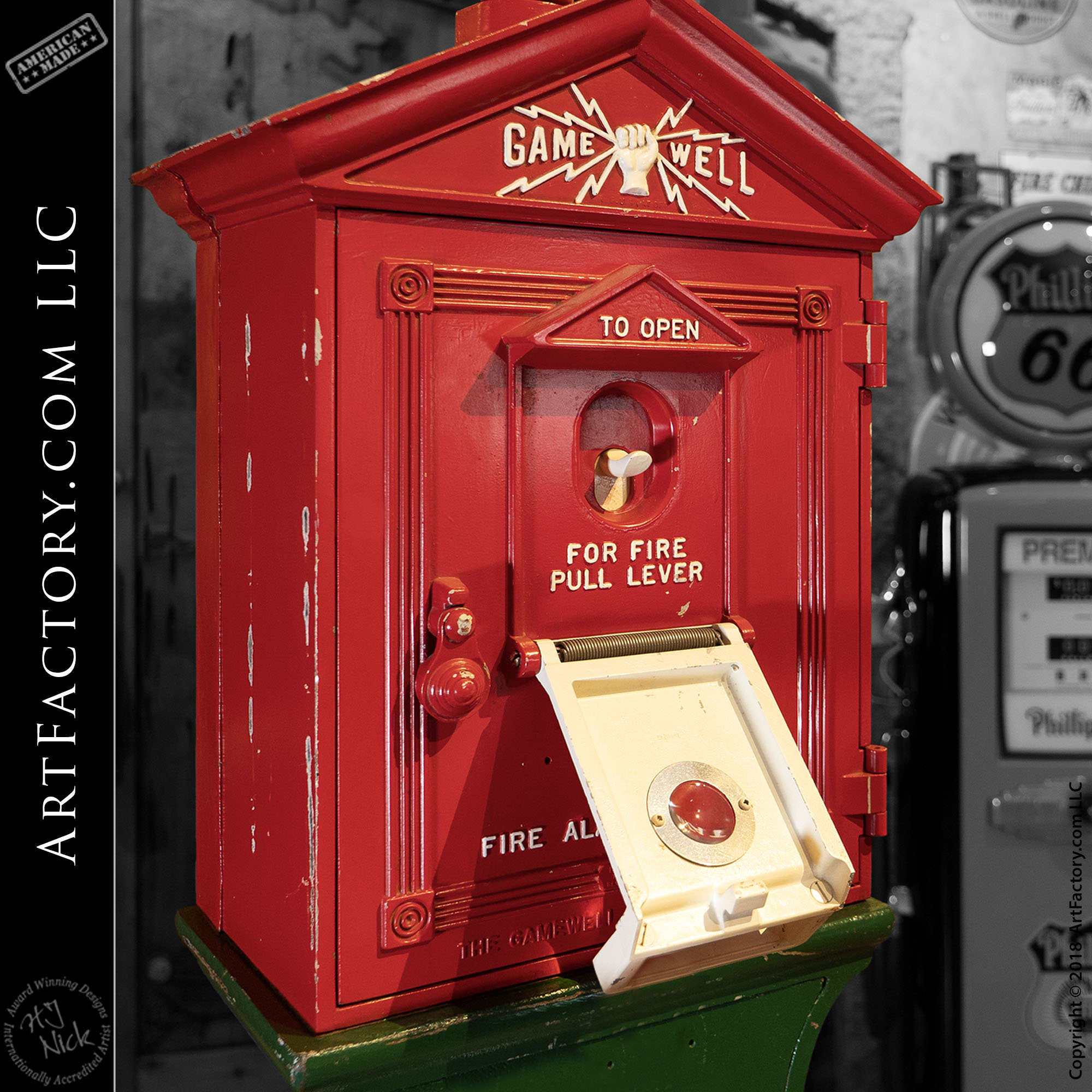
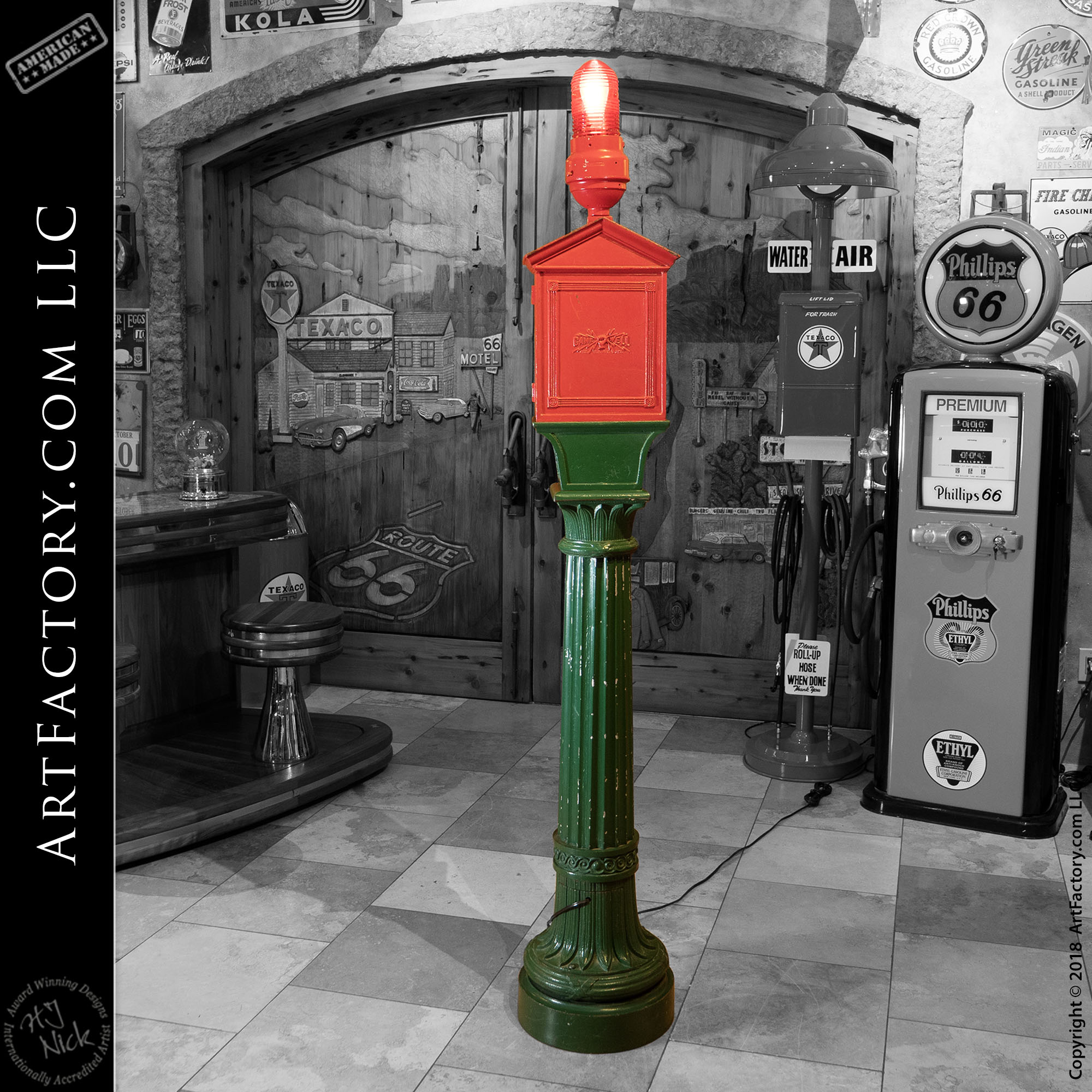
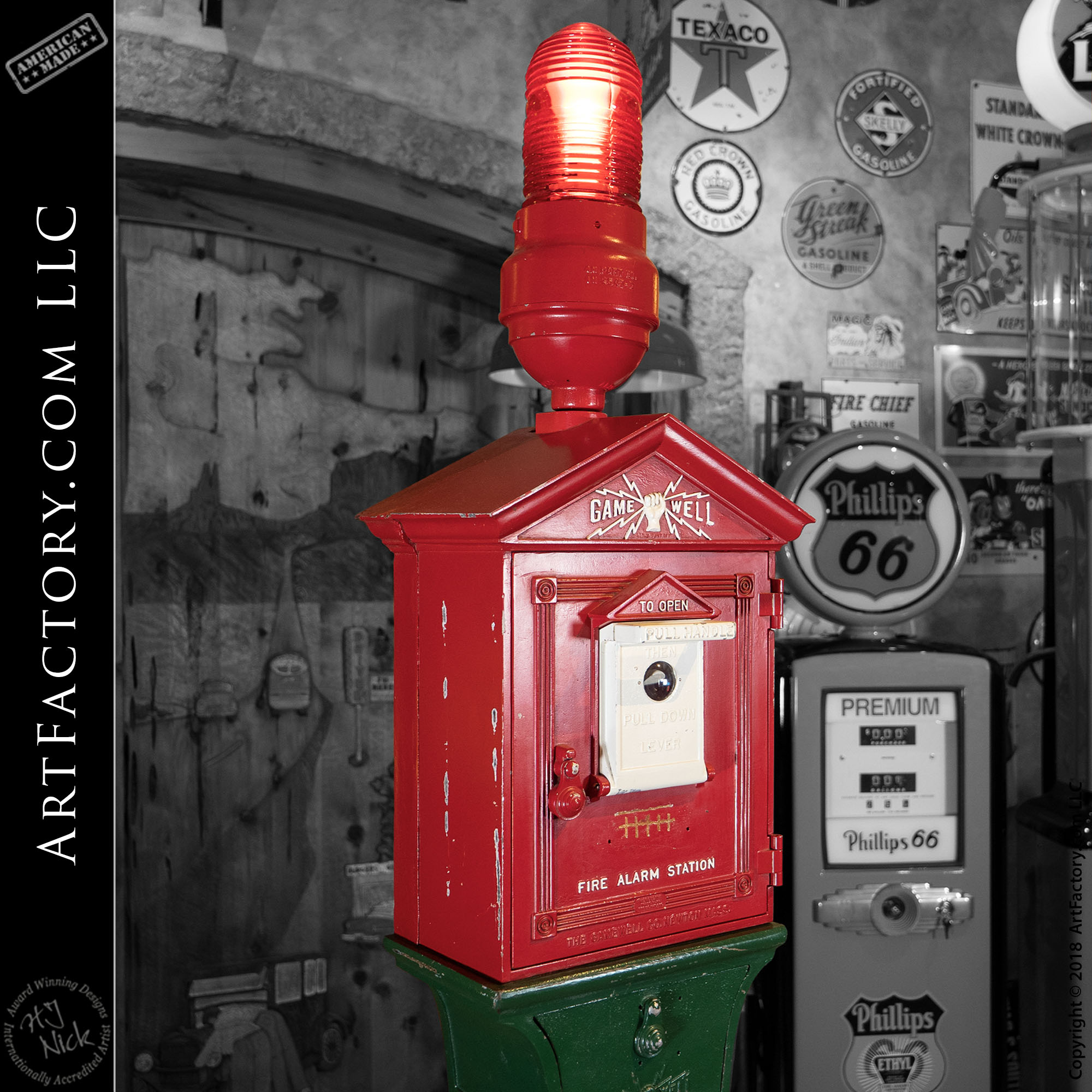
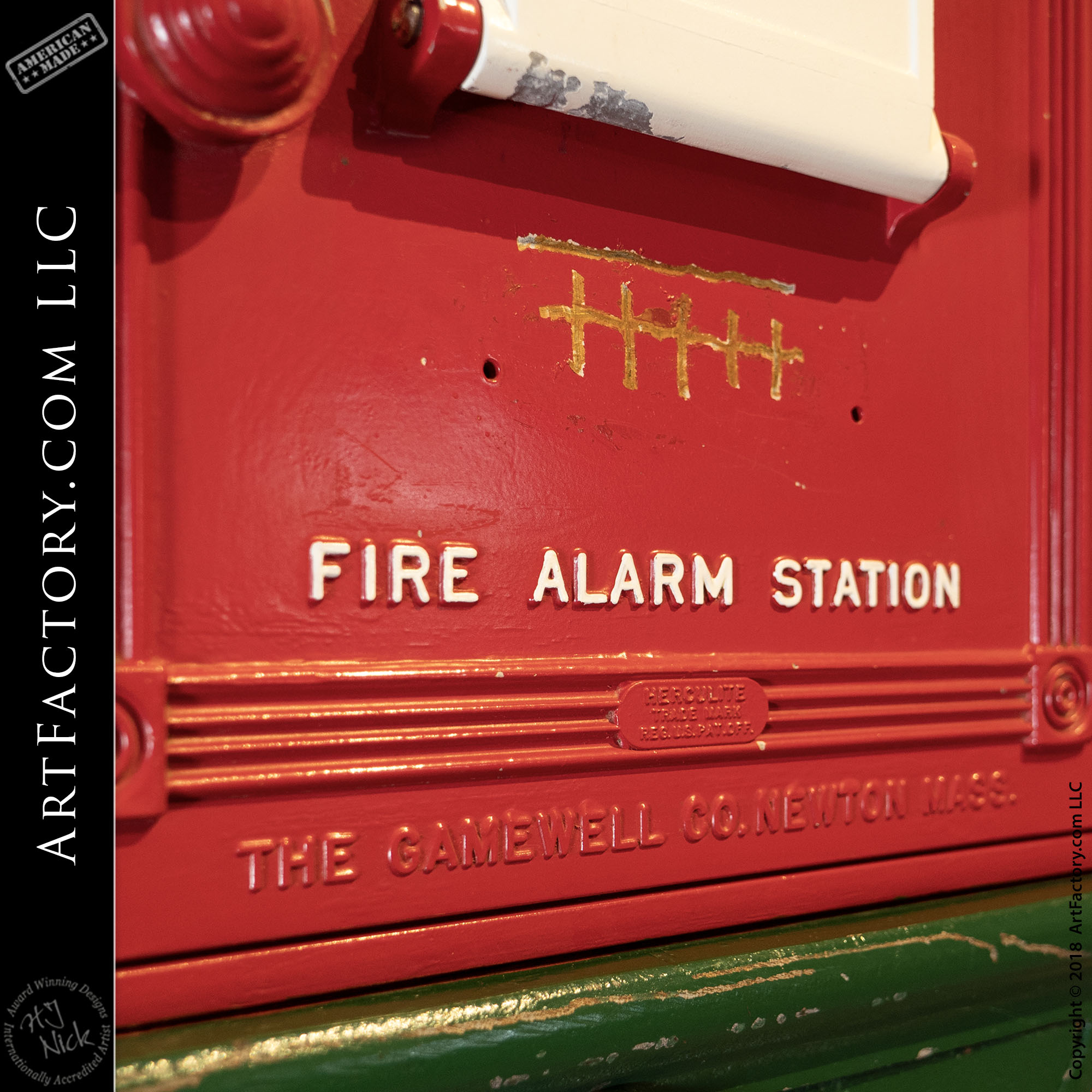
Manufactured by The Gamewell Company of Newton, Massachusetts, this complete apparatus retains its substantial fire-alarm cabinet, decorative cast-iron pedestal, illuminated red glass signal, public pull lever and remarkably preserved three-fold mechanical telegraph transmitter.

Description
Acquired by ArtFactory.com in Walnut Creek, California
ArtFactory.com acquired this Gamewell fire-alarm station approximately ten years ago — around 2016 — in Walnut Creek, California.
It was purchased together with several other historic objects from individuals believed to have been collectors or resellers. Their names and the earlier ownership history of the collection were not recorded.
At the time of purchase, ArtFactory.com was told that the apparatus had remained inside a working fire station throughout its service life. The name of the fire department, the number or address of the station and the city in which the box originally operated were not provided.
Walnut Creek is therefore identified as the documented place of acquisition, not necessarily as the box’s original service location. The account of lifelong indoor fire-station use survives as its reported oral history but has not yet been independently verified.
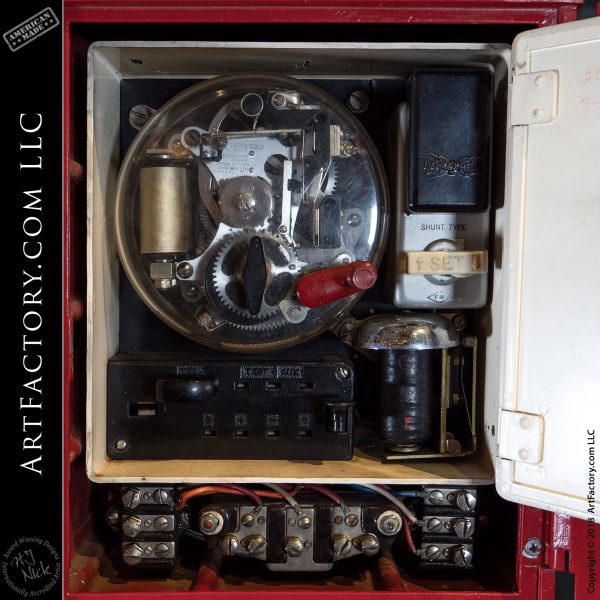
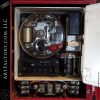
The box remains in unrestored, fully working condition. When the fire lever is pulled, the original mechanism comes to life, setting its gears, code wheel and electrical contacts into motion just as it did during its service life.
This is not an empty alarm-box shell, decorative reproduction or modern assembly. It is a complete working example of one of America’s most important early emergency communication systems.
The most accurate statement of provenance is:
Acquired by ArtFactory.com in Walnut Creek, California, circa 2016, as part of a group of historic objects purchased from unidentified collectors or resellers. At the time of purchase, the apparatus was reported to have remained inside a working fire station throughout its service life. Its original fire department, station and city are presently unknown.
Vintage Gamewell’s Fire Alarm Box Specifications
- Type: Municipal fire-alarm telegraph master box
- Features: Light And Art Deco Pole
- Company: The Gamewell Company
- Place Of Manufacture: Newton, Mass., U.S.A.
- Date Of Manufacture: 1930's - 1950's
- Color: Red/Green
- Pole Color: Green
- Dimensions: Total height 85 inches
- Base 14" diameter
- Fire box is 17" tall, 12 ½" wide, 7" deep
- Light on top is 13 ½" tall
- Condition: Unrestored, preserved and operational "SURVIVOR CONDITION"
- Mechanism: Three-fold coded telegraph transmitter, shunt type
- Configuration: Fire-alarm cabinet, illuminated red signal and decorative cast-iron pedestal
- Reported service history: Believed to have remained inside a working fire station
- Original fire department: Unknown
- Original station and city: Unknown
- Acquired by ArtFactory.com: Walnut Creek, California, circa 2016
- Source: Unidentified collectors or resellers
- Current status: Preserved as part of the ArtFactory.com historic collection
Condition Consistent with Sheltered Fire-Station Placement
The exceptional survival of the apparatus is consistent with its reported indoor history.
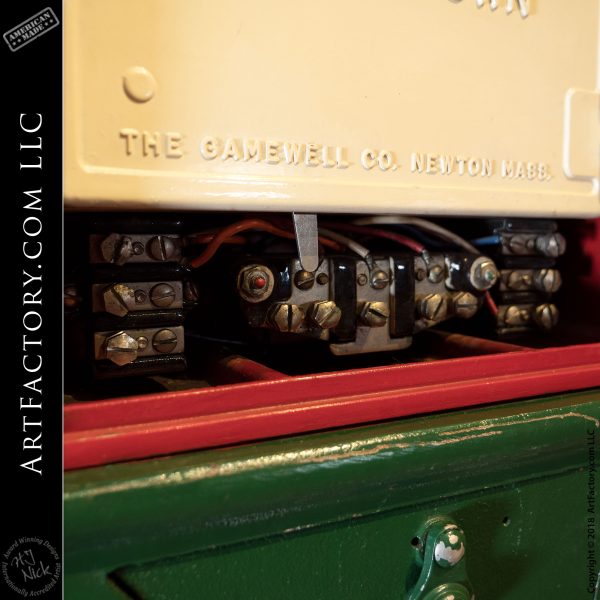
Its precision clockwork movement, porcelain components, electrical terminals, wiring and red glass signal have survived without the extensive corrosion and weather damage commonly found on fire-alarm boxes that spent decades outdoors.
The exterior retains honest scratches, finish losses and evidence of periodic maintenance. These marks are not defects to be erased. They are part of the working history of a piece of municipal emergency equipment that had to remain visible, accessible and ready for immediate use.
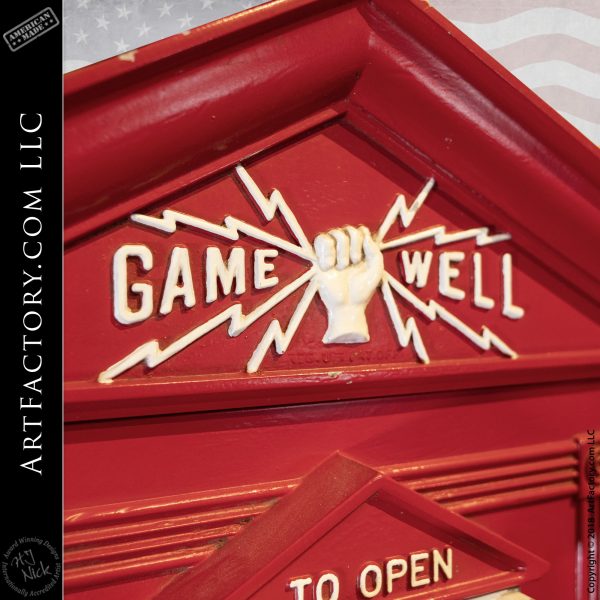
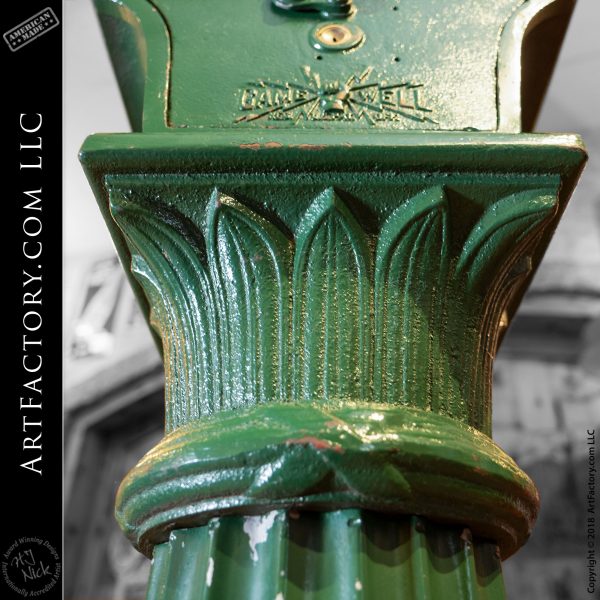
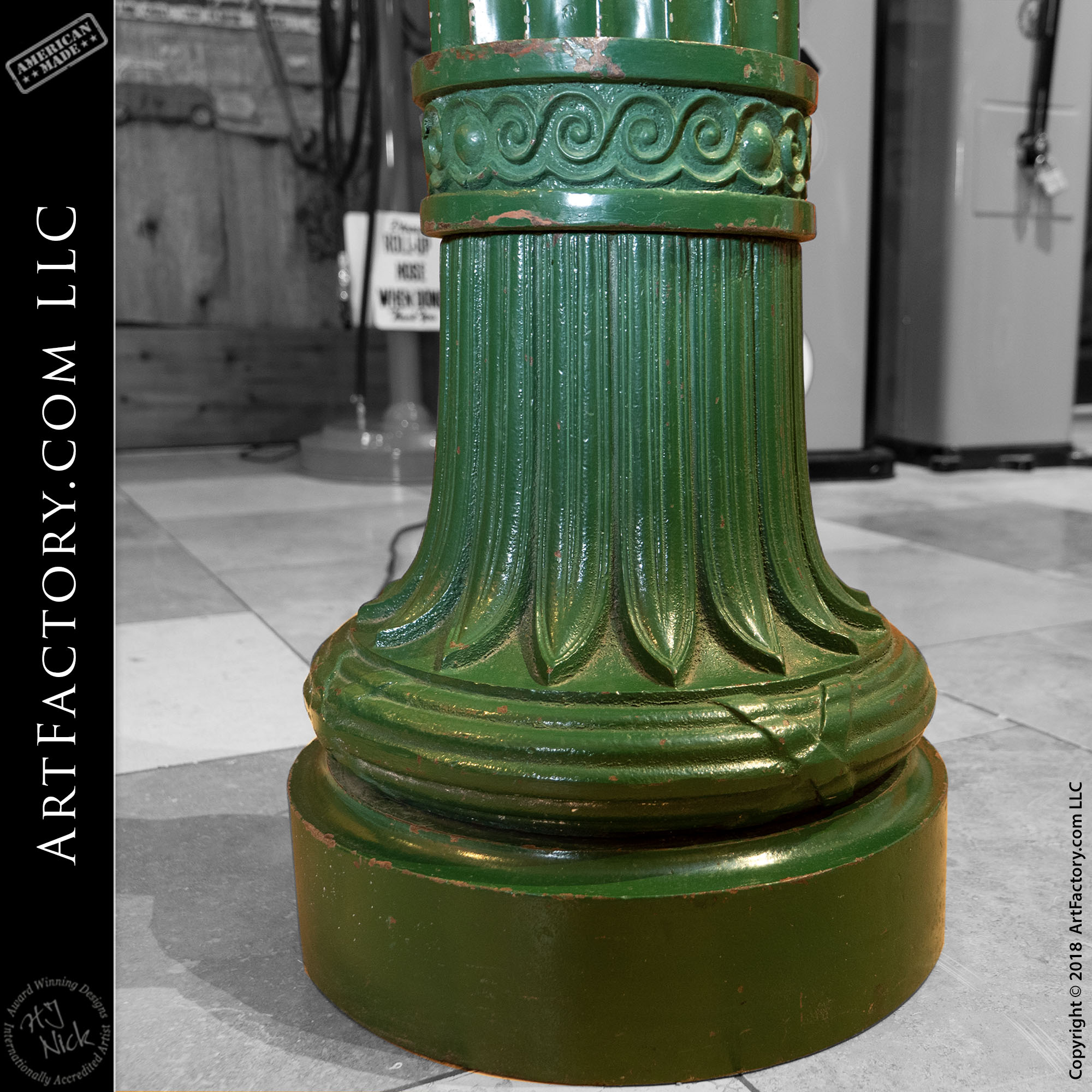
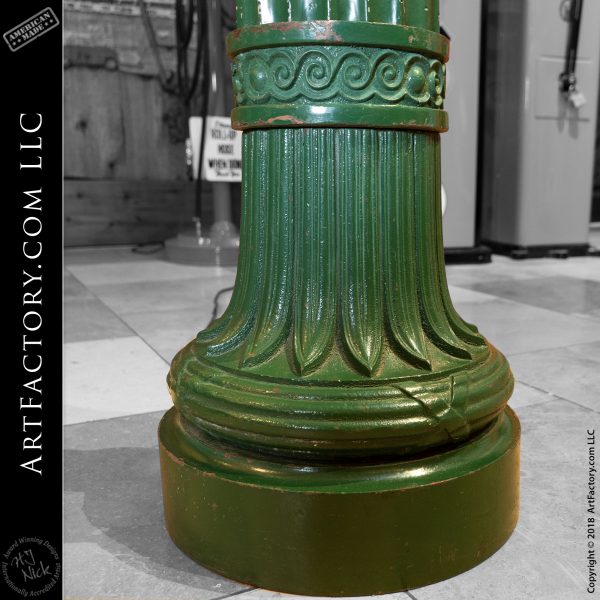
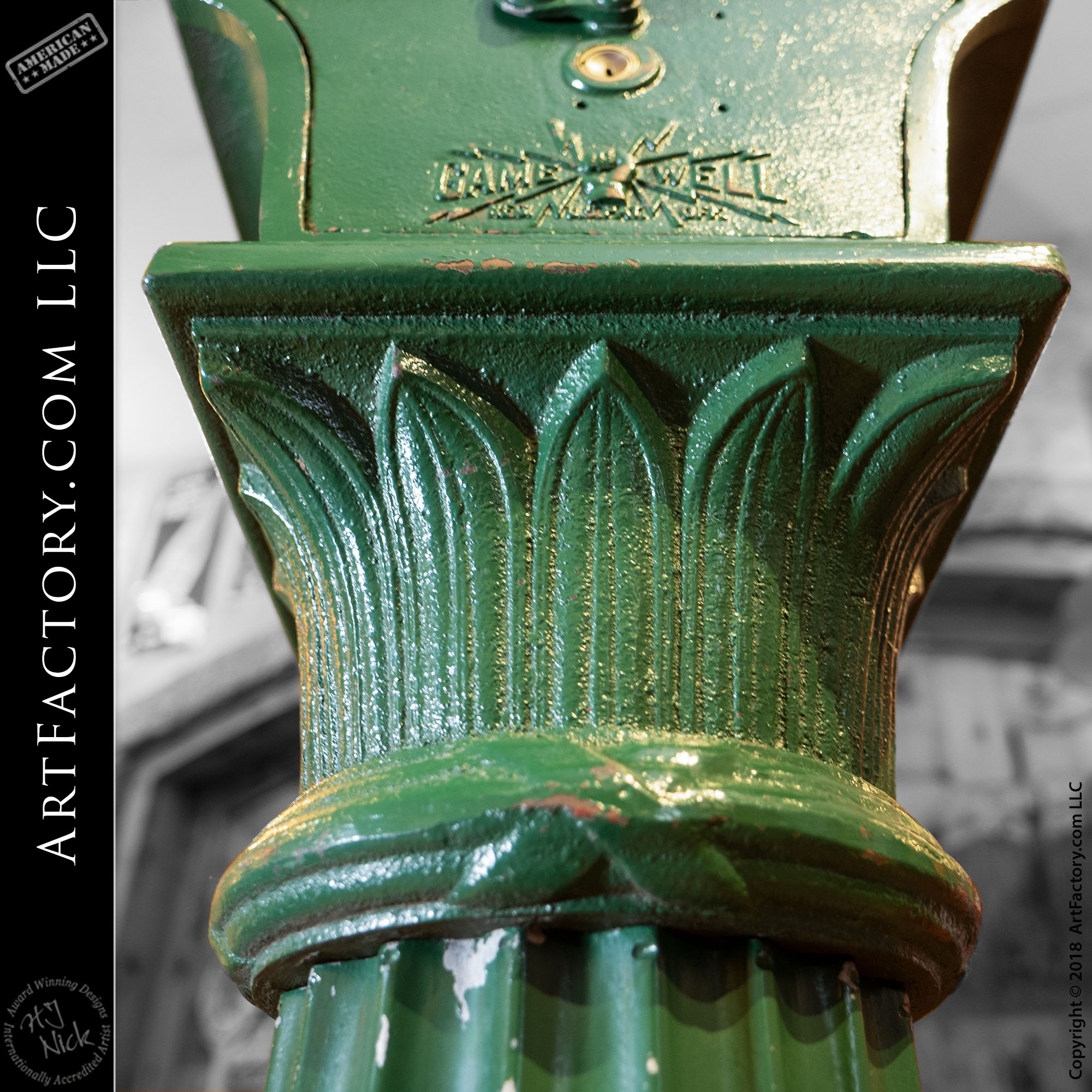
The complete cast-iron pedestal has also survived with its fluted column, decorative capital, substantial base and cast Gamewell trademark intact.
Before the Telephone and 911
Before telephones became common — and long before the establishment of the 911 emergency system — municipal fire-alarm telegraph boxes provided one of the fastest and most dependable ways to summon a fire department.
Gamewell boxes were installed at street intersections, public buildings, factories, schools, hospitals, industrial properties and fire stations. Their familiar red cabinets and illuminated signals made them recognizable emergency landmarks.
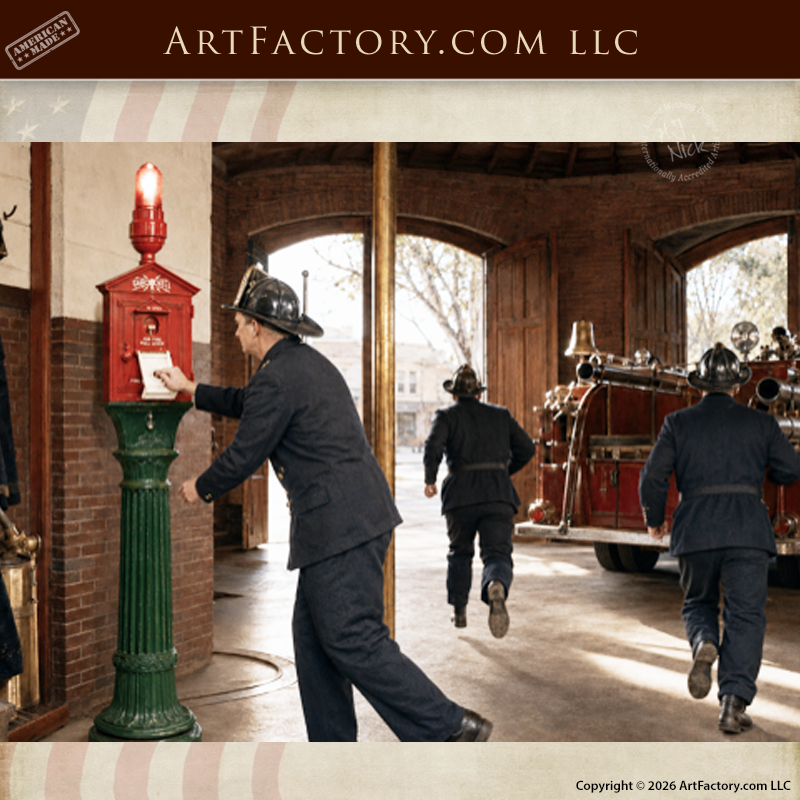
When someone discovered a fire, that person ran to the nearest alarm box, opened its protective cover and pulled the fire lever. The box then transmitted its own identifying number over a dedicated municipal telegraph circuit.
No telephone was required. No spoken message was necessary. The caller did not need to know the complete street address. The mechanical code transmitted by the box told the fire department where the alarm had originated and where firefighters were needed.
The Birth of the Municipal Fire-Alarm Telegraph
The Gamewell story began during the earliest years of electrical communication.
In 1852, Dr. William F. Channing and electrical engineer Moses G. Farmer developed America’s first successful municipal fire-alarm telegraph network in Boston, Massachusetts. The pioneering system connected street alarm boxes with a central receiving station and alarm bells.
John Nelson Gamewell witnessed a demonstration of the invention at the Smithsonian Institution in 1855. Recognizing its enormous public-safety potential, he obtained regional marketing rights and later acquired the patents and full ownership of the system.
The Gamewell Fire Alarm Telegraph Company was organized in 1879. Its equipment soon became the standard for municipal fire-alarm communication throughout the United States.
By the end of the nineteenth century, hundreds of American cities depended upon Gamewell networks. The company’s red alarm boxes became enduring symbols of firefighting, civic preparedness and reliable American engineering.
How the Gamewell System Worked
Each alarm box on a municipal telegraph circuit was assigned an individual number corresponding to its location.
When a box was activated, a spring-driven mechanical transmitter sent that number as a carefully timed series of electrical impulses. The box communicated by repeatedly opening and closing the fire-alarm circuit.
For example, a box assigned the number 2-4-1 would transmit:
- Two electrical impulses
- A pause
- Four electrical impulses
- A pause
- One electrical impulse
The sequence was repeated in rounds so the location could be accurately received and confirmed. At fire-alarm headquarters, the impulses could operate mechanical registers, indicators, perforated paper-tape recorders, bells or large station gongs.
Dispatchers compared the received box number with a directory containing the location and its predetermined response assignment. Engine companies, ladder companies and other necessary equipment could then be dispatched immediately.
Fire stations connected to the circuit also received the code on mechanical gongs. Experienced firefighters learned to recognize important box numbers simply by hearing the pattern struck inside the station.
Pulling the Fire Lever
The public operation of a Gamewell box was intentionally simple.
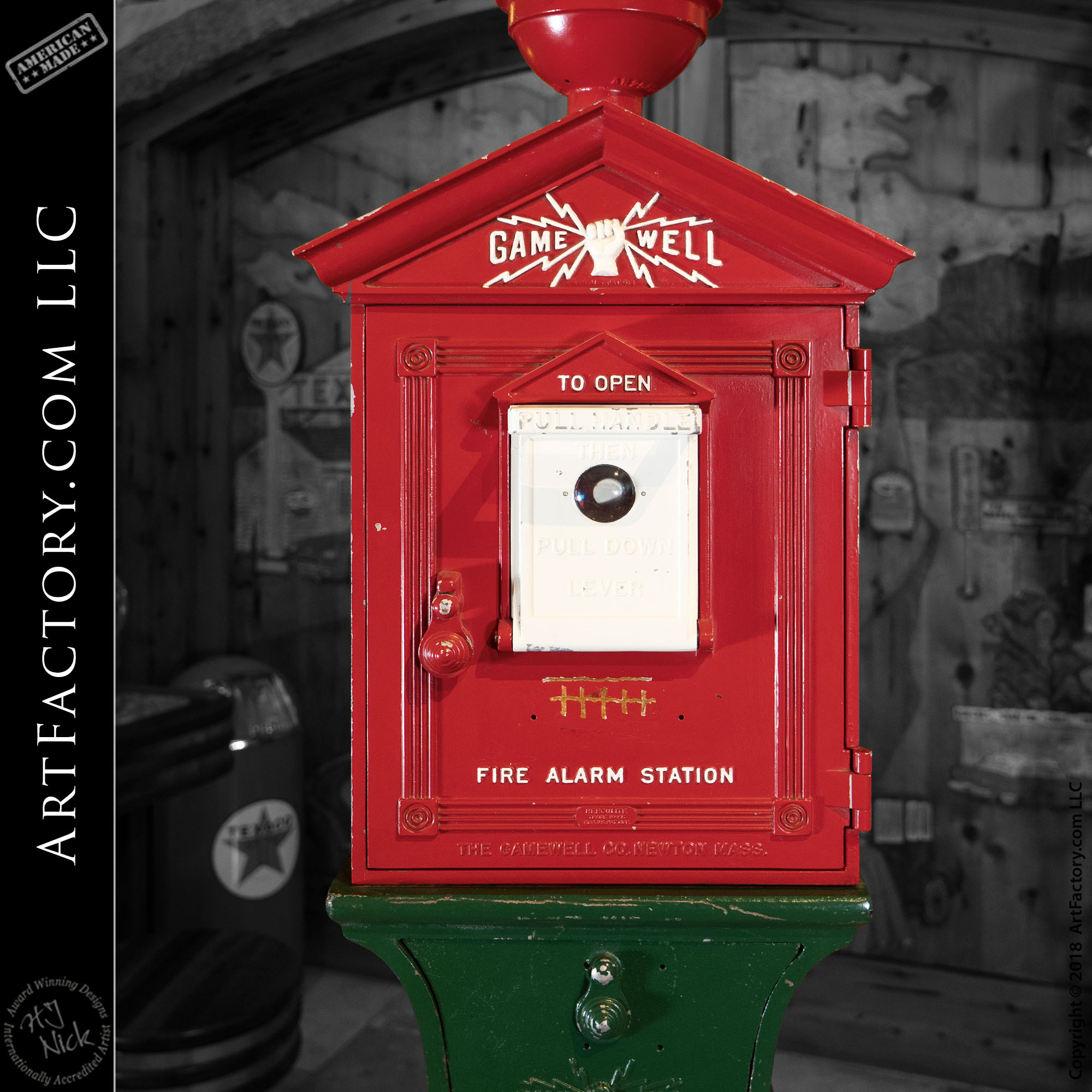
In an emergency, a citizen or firefighter opened the quick-action exterior cover and pulled down the fire lever. That single action released the internal mechanism.
Once activated, the box automatically completed its signaling sequence. The caller did not have to hold the lever, speak with an operator or perform any additional action.
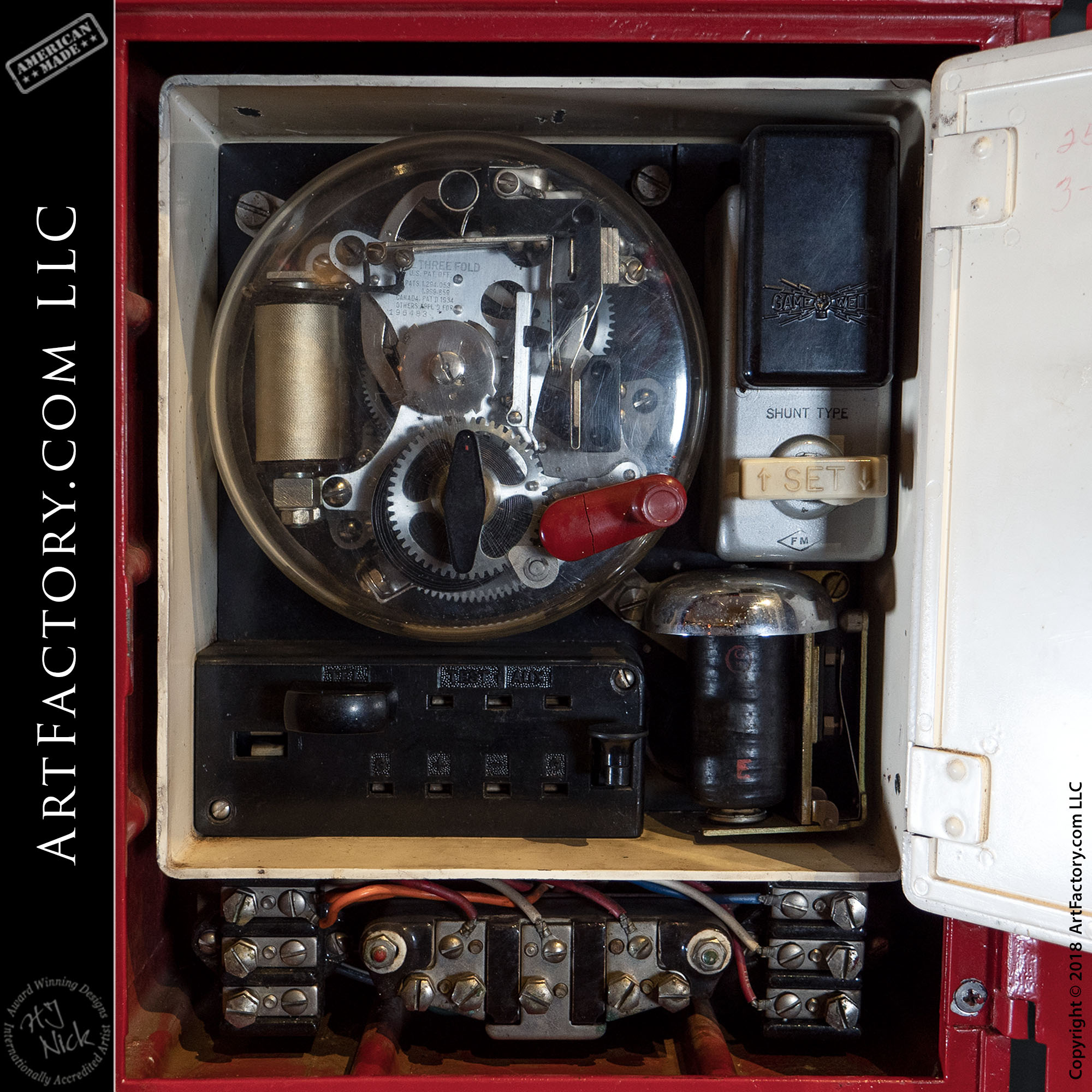
Inside the cabinet, the spring-driven movement rotated a specially configured code wheel. Cams and contacts opened and closed the electrical circuit in the exact pattern assigned to that box.
The operation was entirely mechanical and electromechanical—an extraordinary combination of foundry work, clockmaking, telegraphy and municipal engineering.
The Gamewell Three-Fold Mechanism
At the heart of this apparatus is a sophisticated Gamewell three-fold coded telegraph mechanism.
Municipal alarm boxes often shared a common telegraph circuit. If two boxes were pulled at nearly the same time, their signals could not be allowed to overlap and create an incorrect location code.
The three-fold mechanism was designed to recognize when another alarm box had control of the line. It could wait, make repeated attempts to obtain a clear circuit and then transmit multiple rounds of its own identifying number.
Certain versions could ultimately take control of an occupied circuit if an emergency signal could not otherwise be transmitted. Gamewell referred to this forceful emergency function as “bulldogging” the line.
This ingenious non-interfering and successive operation helped make Gamewell systems exceptionally dependable.
The box did not merely ring a local bell. It communicated a precise mechanical identity across a shared emergency network.
A Master Fire-Alarm Box
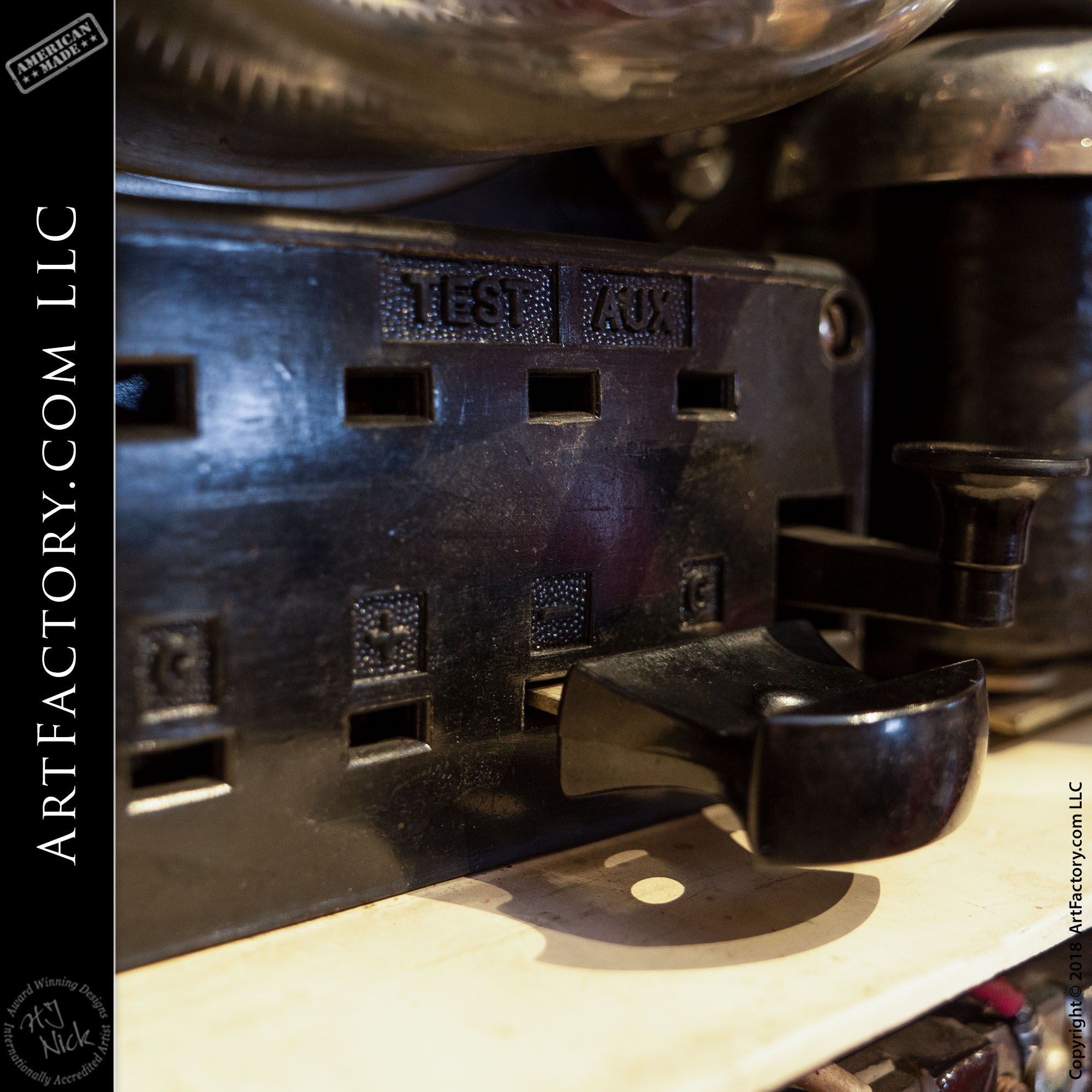
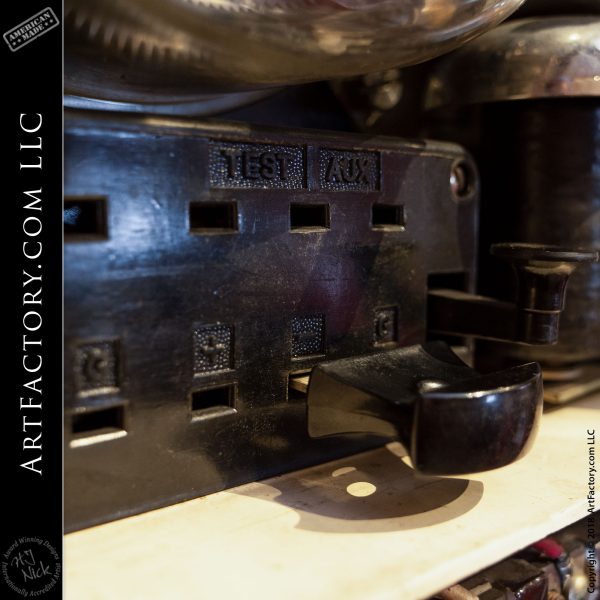
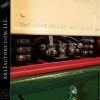
The visible TEST, AUX and SHUNT TYPE markings identify this as a more sophisticated apparatus than a basic manual street pull box.
A Gamewell master box could be activated manually by pulling its exterior lever. Depending upon its original configuration, it could also be connected to auxiliary fire-protection equipment.
Such equipment might have included:
- A protected building fire-alarm system
- Automatic sprinkler equipment
- Heat-detection equipment
- Industrial fire-protection systems
- Another supervised emergency circuit
When the connected equipment operated, the master box could transmit its assigned coded location over the municipal telegraph circuit.
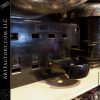
The internal test positions and telegraph key allowed authorized fire-alarm personnel to inspect, test and service portions of the equipment. These features are especially consistent with use inside a fire station, industrial firehouse, public building or other controlled location.
Why a Complete Box Might Have Stood Inside a Fire Station
Although many Gamewell boxes were installed outdoors, fire-alarm stations could also be placed inside or near the protected entrance of a working firehouse.
Inside a fire station, a box like this could have served as:
- A manual transmitting point connected to the municipal circuit
- An emergency station-house alarm
- A master box connected to auxiliary equipment
- A testing and maintenance point for alarm technicians
- A public alarm point near the firehouse entrance
- A training and demonstration station for firefighters
- A means of transmitting the fire station’s assigned code
Its tall cast-iron pedestal allowed the telegraph wiring to enter from below while positioning the alarm cabinet at a convenient operating height. The illuminated red signal made the box immediately recognizable in a public entrance, watch room or apparatus area.
The Purpose of the Illuminated Red Signal
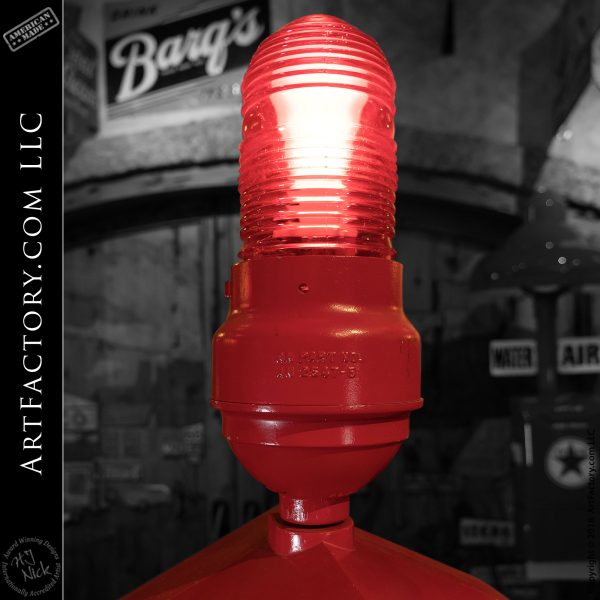
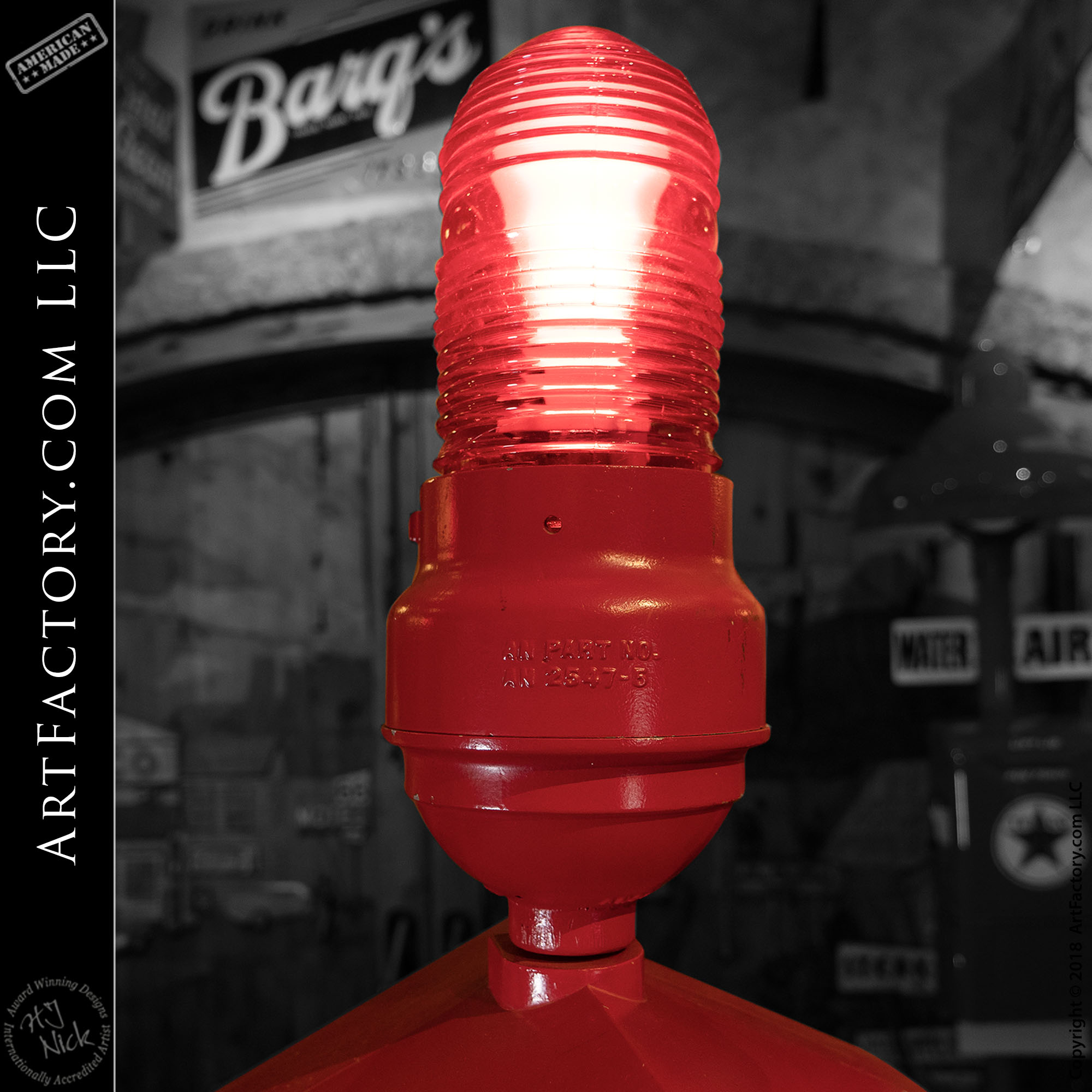
The ribbed red glass signal at the top of the station made the alarm box visible and easy to identify.
Depending upon the municipality and the box’s wiring arrangement, the lamp could have been illuminated continuously as a location marker or incorporated into a locally configured indicating circuit.
At night, during heavy weather or inside a dimly lit firehouse, the glowing red signal immediately announced the location of the emergency alarm station. The survival of this delicate lens and its substantial cast housing adds greatly to the completeness and visual presence of the apparatus.
A Complete Working Assembly
Many historic fire-alarm boxes survive only as empty cabinets. Their mechanisms, doors, lights, pedestals or internal components were often removed when municipal systems were modernized.
This Gamewell station retains the principal elements necessary to understand how the original apparatus was constructed and operated:
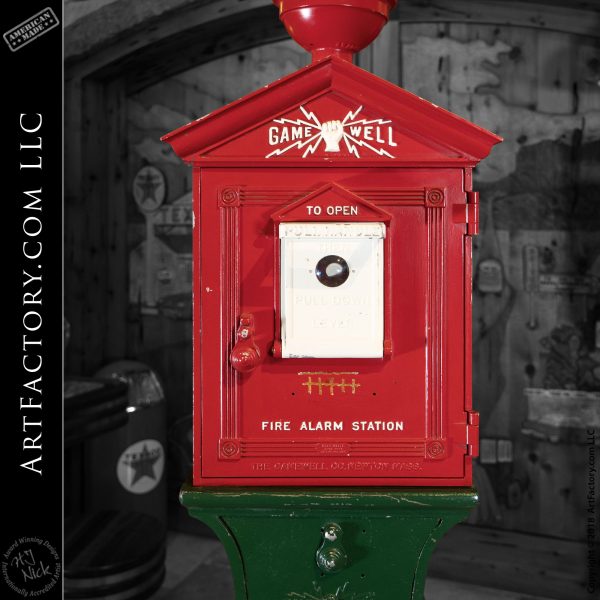
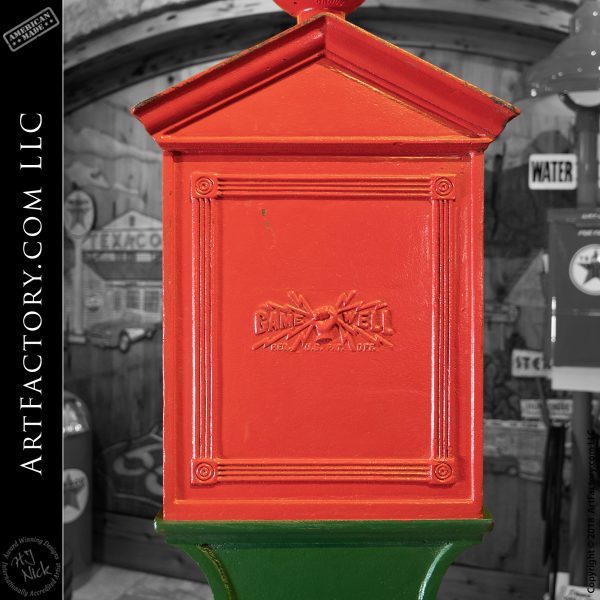
- Gabled Gamewell fire-alarm cabinet
- Gamewell fist-and-lightning trademark
- Public quick-action cover
- Fire pull lever
- Locked municipal service compartment
- Porcelain-covered internal assembly
- Three-fold clockwork coded transmitter
- Code gearing and electrical contacts
- Shunt-type auxiliary equipment
- Test controls
- Telegraph key
- Terminal blocks
- Historic internal wiring
- Illuminated red glass signal
- Decorative cast-iron pedestal
- Fluted column
- Ornamental capital
- Substantial cast-iron base
The survival of the cabinet, mechanism, signal and pedestal together distinguishes this apparatus from incomplete wall boxes and decorative display pieces.
It can be experienced as a complete working alarm station, not merely as a collection of unrelated parts.
Preserved Rather Than Restored
This Gamewell station has not been cosmetically restored to make it appear new.
Its scratches, finish losses, operating marks and evidence of maintenance remain visible. These characteristics preserve the honest appearance of equipment that once served a serious public-safety purpose.
Municipal fire-alarm boxes were working machines. During their service lives, they were inspected, repaired, adjusted and repainted whenever necessary. A fire department’s responsibility was to keep the apparatus visible, protected and operational — not to preserve it as a museum object.
For that reason, “unrestored” should not be interpreted to mean that the box was never maintained or repainted while in service. Its existing finish may include historic service-applied coatings.
The appropriate description is:
Preserved in unrestored, as-acquired service condition, retaining historic wear and a complete operational mechanism.
An Early Addressable Emergency System
In modern terms, the Gamewell fire-alarm box was an early addressable signaling device.
Its rotating code wheel performed mechanically what digital electronics accomplish today: it transmitted the unique identity and location of the initiating device.
The system did not depend upon a telephone conversation. A caller did not need to describe the fire, remember an address or wait for an operator. One pull released the mechanism, and the machine transmitted its location automatically.
Its rugged simplicity allowed municipal fire-alarm telegraph networks to function under conditions that could interrupt ordinary communication, including electrical failures, severe storms, earthquakes and overloaded telephone systems.
This dependable redundancy made fire-alarm telegraph networks especially valuable to major American cities.
A Monument to American Firefighters and Master Engineering
This working Gamewell station represents an era when every gear, spring, electrical contact and cast-metal component had to perform with absolute dependability.
It stands as a monument to:
- The firefighters who answered its alarms
- The alarm operators who interpreted its signals
- The municipal electricians who maintained the circuits
- The engineers who developed its precision mechanism
- The foundry craftsmen who produced its substantial housings
- The communities that depended upon it in moments of danger
Its exterior possesses the commanding architectural presence expected of important public equipment. Its interior reveals a level of mechanical craftsmanship rarely encountered in modern emergency systems.
The illuminated red signal still announces its purpose. The cast-iron pedestal still gives the station a powerful civic presence. Most importantly, its mechanical heart continues to operate.
More than an antique, this complete Gamewell station is a working survivor of the communications network that protected American cities before radio dispatch, digital electronics and 911.
An Important History Still Waiting to Be Identified
The loss of the original fire department’s name does not diminish the authenticity of the apparatus. Instead, it leaves an important opportunity for future research.
The box’s assigned code, serial markings, internal service notes, inspection records or hidden property numbers may eventually connect it to the department and community it once protected.
Any future identification should be based upon physical markings or surviving municipal records. Until such documentation is discovered, the apparatus will be represented honestly as a complete, operational Gamewell fire-alarm station with reported indoor firehouse history, acquired by ArtFactory.com in Walnut Creek, California, circa 2016.
Vintage Gamewell’s Fire Alarm Box Info
All Vintage Memorabilia Offered Is A Genuine Collectable And Appreciable Asset
All Items Are Of Highest Museum Quality World Class Collector Level
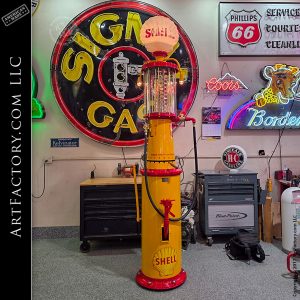
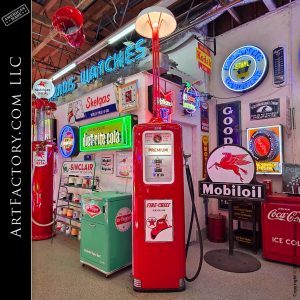
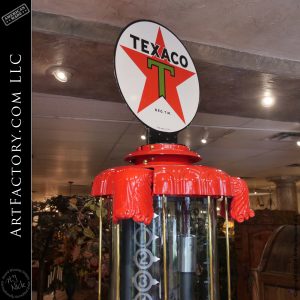
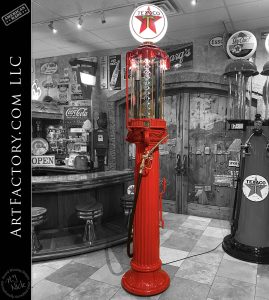
Our Latest Museum Quality Fully Restored Vintage Visible Gas Pumps







✨ Visit H.J. Nick’s Art Factory Galleries ✨
7407 E Greenway Rd, Scottsdale Airpark, Scottsdale, AZ 85260
Monday – Friday | 8 AM – 4 PM MST
Walk-ins Welcome | Private Viewings by Appointment
📅 Appointments & Inquiries
📞 Call: 1-800-292-0008 – Ask for Karla
🌐 Website: www.artfactory.com

• ✈️ Jet Parking Available
• 🚗 Limousine Service Available

Reviews
There are no reviews yet.